

To build a foundation for success, it is helpful to understand the science of habits and how they actually form in the brain.
You’ve been here before. You decide this is the month you’ll finally start meditating, or exercising, or reading every day. You buy the new yoga mat, download the app, and set a determined alarm. The first few days feel great. You’re riding a wave of motivation, feeling proud and accomplished. But then life happens. A stressful day at work, a late night out, or just a simple dip in energy, and you miss a day. Then another. Soon, the new yoga mat is gathering dust, and the feeling of failure quietly settles in.
If this sounds familiar, you are not alone, and you are not a failure. The problem isn’t your willpower. For most of us, especially those living in busy, modern environments, willpower is a fragile and finite resource. Our cities and digital spaces are engineered with a million tiny distractions, each one chipping away at our resolve. Relying on sheer determination to build a new habit in this environment is like trying to build a sandcastle during high tide. It’s exhausting and, ultimately, unsustainable.
The good news is that there is a better, gentler, and far more effective way. The secret to how to make a habit stick for the long haul isn’t about white-knuckling your way through temptation. It’s about thoughtful design. It’s about understanding the mechanics of your own mind and creating a system that works with your human nature, not against it. It’s about making your desired behaviors so easy and natural that they become the path of least resistance.
In this guide, we will walk you through the process of making your habits “habit-proof.” We won’t ask you to try harder. Instead, we’ll show you how to work smarter. We will explore how to build a robust foundation for your new routines, how to design them for resilience, and most importantly, how to get back on track without shame when you inevitably stumble. This is your blueprint for creating durable, life-enhancing habits that last, helping you avoid habit relapse for good.
📚 Table of Contents
- The Hidden Blueprint of Your Brain: Understanding the Habit Loop and Identity
- Step 1: The Cue (The Trigger)
- Step 2: The Action (The Routine)
- Step 3: The Reward (The Payoff)
- Beyond Actions: The Power of Identity-Based Habits
- Designing for Success: How to Architect a Truly “Habit-Proof” Routine
- Start with the Minimum Viable Action (MVA)
- Conduct a “Friction Audit” on Your Life
- Engineer Your Environment with Cues
- Introduce Gentle Accountability
- Building Resilience: How to Safeguard Your Habits Against Failure
- Create a Relapse Plan: The “If-Then” Strategy
- Understand the Psychology of Streaks (and When to Let Them Go)
- Practice the Art of the Shame-Free Reset
- Putting It All Together: Worked Examples in Prose
- Frequently Asked Questions About Habit Building
- How long does it really take to form a habit?
- What should I do on sick days or travel days? I don’t want to break my streak!
- I’ve been consistent, but I’ve hit a plateau. What now?
- Can I try to build multiple new habits at once?
- My reward doesn’t feel rewarding enough. How do I fix that?
- Your First Steps to a “Habit-Proof” Life
The Hidden Blueprint of Your Brain: Understanding the Habit Loop and Identity
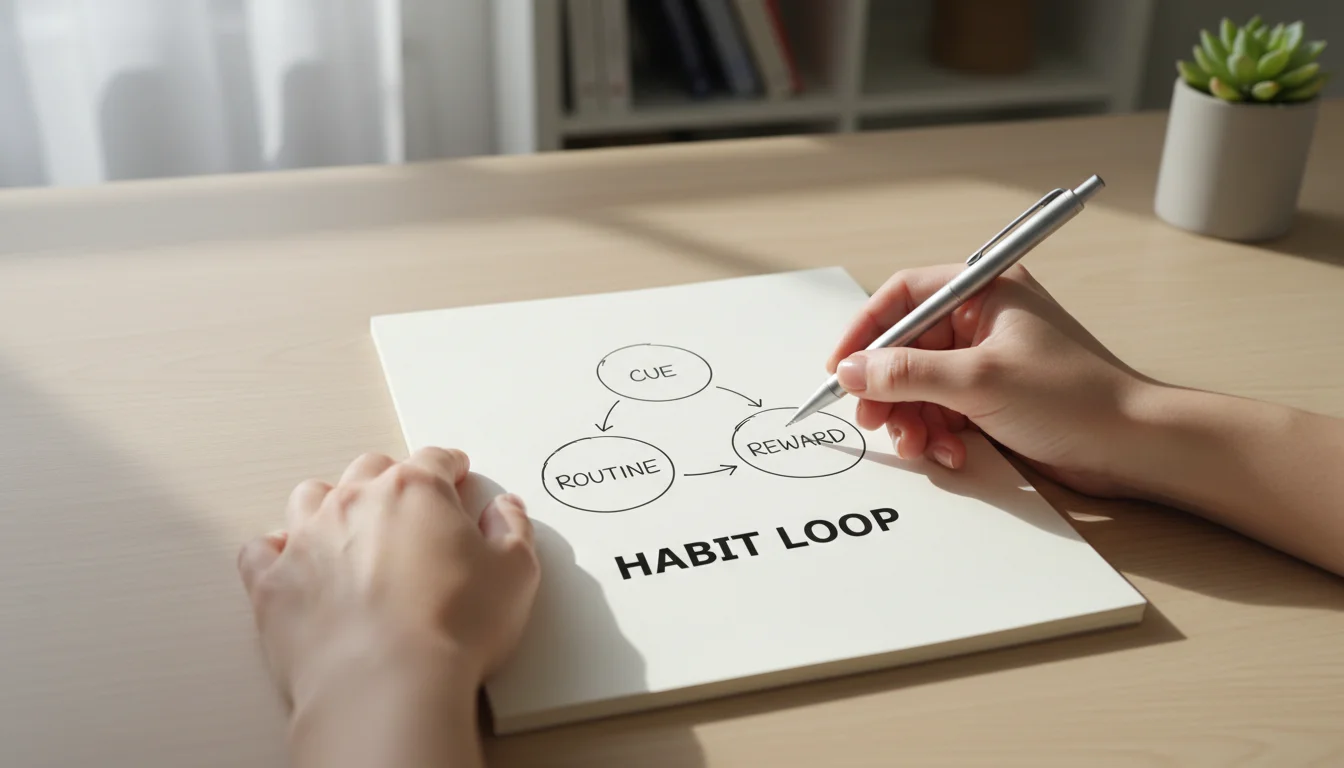
Before we can build a habit that lasts, we need to understand how habits are formed in the first place. You might think it’s a matter of repetition alone, but there’s a specific neurological process at play. Researchers refer to this as the “habit loop,” a simple three-step pattern that your brain runs on autopilot. Understanding this loop is the first step toward re-engineering it in your favor.
Step 1: The Cue (The Trigger)
A habit always begins with a cue. This is a trigger that tells your brain to go into automatic mode and which habit to use. Cues can be almost anything: a time of day (your 3:00 PM energy slump), a location (walking into the kitchen), an emotional state (feeling stressed or bored), or the preceding action in a sequence (finishing dinner).
Think about your phone. The cue might be the buzz of a notification, the sight of the phone on your desk, or even just a moment of downtime between tasks. Your brain instantly recognizes this cue and knows what comes next.
Step 2: The Action (The Routine)
The action, or routine, is the habit itself—the physical or mental behavior you perform. It’s the thing you think of as the habit. After the cue of your phone buzzing, the action is picking it up and opening your social media app. After the cue of feeling stressed, the action might be reaching for a sugary snack. This is the part we often focus on changing, but it’s only one piece of the puzzle.
Step 3: The Reward (The Payoff)
The reward is the final, crucial step. This is what satisfies the craving that the cue initiated and teaches your brain that this particular loop is worth remembering for the future. For the phone habit, the reward is a little hit of novelty or social connection. For the snack habit, it’s the rush of sugar and the temporary relief from stress. If the reward is positive, your brain learns to associate the cue with that reward, solidifying the action in between. Without a satisfying reward, a habit won’t form.
This cue-action-reward cycle is the fundamental mechanism behind every habit you have, good or bad. The key to successful habit sticking is not to fight this loop, but to design a new one that serves you better.
Beyond Actions: The Power of Identity-Based Habits
Now, here’s where we move from simple mechanics to profound, lasting change. Many people approach habits with an outcome-based goal: “I want to lose 15 pounds,” or “I want to write a book.” The problem with this approach is that you are always postponing success until you hit the big milestone. It creates a constant sense of falling short.
A more powerful framework is the identity-based habit. This approach flips the script. Instead of focusing on what you want to achieve, you focus on who you want to become.
Consider the difference:
- Outcome-Based Goal: “I want to run a marathon.”
- Identity-Based Goal: “I want to become a runner.”
The person who wants to run a marathon might train hard, but once the race is over, the motivation can evaporate. The person who is becoming a runner doesn’t stop after one race. They run because it’s part of who they are. Every run, no matter how short, is a vote for that new identity. It reinforces the belief: “I am a runner.”
This shift is subtle but transformative. When you want to build a reading habit, don’t just say, “I want to read 20 books this year.” Instead, tell yourself, “I am becoming a reader.” What does a reader do? They read every day, even if it’s just one page. Each page you read casts a vote for your new identity. This makes the process itself the reward, not just some far-off goal. It makes habit sticking an act of self-definition, which is far more motivating than just checking a box.

Designing for Success: How to Architect a Truly “Habit-Proof” Routine
With a clear understanding of the habit loop and the power of identity, we can move from theory to practice. Making a habit “habit-proof” is an act of architecture, not of willpower. You are the architect of your life, and your job is to design a system where your desired habits can thrive. This involves making good habits easy, obvious, and satisfying, while making bad habits difficult, invisible, and unsatisfying.
Start with the Minimum Viable Action (MVA)
One of the biggest reasons for habit relapse is starting too big. We get swept up in enthusiasm and commit to a 60-minute workout or 30 minutes of meditation every day. This is often unsustainable. The key is to start with what we call a Minimum Viable Action, or MVA. An MVA is the smallest possible version of your habit that still counts as a win and moves you forward. It should be so easy that you can’t say no.
Think “two-minute rule.” Your new habit should take less than two minutes to do.
- “Read every day” becomes “Read one page.”
- “Do yoga” becomes “Roll out my yoga mat.”
- “Meditate for 20 minutes” becomes “Sit and breathe for 60 seconds.”
- “Write a novel” becomes “Write one sentence.”
The MVA is not the end goal, but it is the critical first step. It helps you overcome the initial resistance and inertia. Anyone can read one page. Anyone can breathe for one minute. By doing the MVA, you are casting a vote for your new identity. You are showing up. Once you’ve started, it’s much easier to continue. Maybe you’ll only read one page, and that’s a win. But often, you’ll find yourself reading for ten minutes. The goal of the MVA is simply to master the art of showing up.
Conduct a “Friction Audit” on Your Life
Every action you take has a certain amount of “friction” associated with it—the effort, time, and decision-making required to perform it. To make good habits stick and bad habits fade, you must consciously manage this friction.
To build a good habit, reduce the friction. Make it as easy as possible to do the right thing. This is a core principle for anyone wondering how to make a habit stick.
- Want to exercise in the morning? Lay out your workout clothes, shoes, and water bottle the night before.
- Want to eat healthier? Pre-chop vegetables on Sunday so they’re ready to go for the week.
- Want to journal? Leave your notebook and a pen open on your nightstand.
To break a bad habit, increase the friction. Make it as difficult as possible to do the wrong thing.
- Want to watch less TV? Unplug it after each use and put the remote in another room.
- Want to stop mindlessly scrolling on your phone? Delete social media apps and only use the browser version, or set up screen time limits that require a password.
- Want to eat less junk food? Don’t keep it in the house. The friction of having to go to the store is often enough to stop the craving.
Engineer Your Environment with Cues
Your environment is the invisible hand that shapes your behavior. As we learned from the habit loop, habits are triggered by cues. The most effective way to ensure habit sticking is to make the cues for your good habits obvious and visible, and the cues for your bad habits invisible.
If you want to remember to take your vitamins, don’t hide them in a cabinet. Put the bottle right next to your coffee maker. If you want to practice guitar, don’t keep it in its case in the closet. Put it on a stand in the middle of your living room. You want to stumble over your good intentions.
Conversely, if you’re trying to drink less soda, remove it from the front of the fridge. Hide it, or better yet, don’t buy it. If your phone is the first thing you reach for in the morning, charge it in a different room overnight. By curating your space, you are pre-making decisions for your future self. You’re making it easy to succeed.
Introduce Gentle Accountability
Accountability can be a powerful motivator, but it doesn’t have to be punitive. The mere act of knowing someone else is paying attention can be a powerful incentive to follow through. Find a “habit buddy” and agree to text each other a simple “done” each day after you’ve completed your MVA. You don’t need to share details or judge each other; the simple act of checking in provides a positive social cue.
Another form of accountability is tracking. A simple calendar where you put an ‘X’ on each day you complete your habit can be incredibly satisfying. The goal isn’t to create an unbroken chain (more on that later), but to have a visual representation of your effort. It proves to yourself that you are showing up, reinforcing that new identity you’re building.

Building Resilience: How to Safeguard Your Habits Against Failure
Even with the best-designed system, life will inevitably get in the way. You’ll get sick, you’ll travel, you’ll have a day where you are completely drained. This is not failure; it is reality. The difference between someone whose habits stick and someone who gives up is not that the first person never messes up. It’s that they have a plan for when they do. This is how you truly avoid habit relapse.
Create a Relapse Plan: The “If-Then” Strategy
A habit relapse often starts with a single missed day. The danger is the “all-or-nothing” mindset that follows. We think, “Well, I’ve already blown it today, so I might as well give up for the week.” This is a cognitive trap. Instead, plan for imperfection ahead of time with an “If-Then” strategy.
The formula is simple: If [I miss my planned habit], then [I will do this alternative behavior].
- “If I miss my morning run because of rain, then I will do a 10-minute bodyweight workout at home.”
- “If I’m too tired to read a chapter of my book, then I will read one page.” (Notice how the MVA can be a fallback).
- “If I eat an unhealthy lunch, then I will make sure my dinner is packed with vegetables.”
This strategy prevents one small slip-up from derailing your entire progress. It gives you a pre-planned, automatic way to get back on track immediately. It transforms a moment of potential failure into an opportunity to practice resilience.
Understand the Psychology of Streaks (and When to Let Them Go)
Tracking your habit with a streak—an unbroken chain of successful days—can be incredibly motivating. Watching the chain grow provides a satisfying reward and can pull you through on days when you lack motivation. Apps and calendars are great for visualizing this progress.
However, streaks have a dark side. When we place too much importance on an unbroken chain, breaking it can feel catastrophic. It can trigger that same all-or-nothing thinking that leads to giving up entirely. The feeling of losing a “100-day streak” can be so demoralizing that it makes it harder to start over.
A healthier approach is to embrace the rule: Never miss twice.
Missing one day is an accident. It’s life. Missing two days in a row is the start of a new (undesirable) habit. This mindset provides the flexibility to be human while maintaining a strong commitment to your identity. If you miss your workout on Tuesday, make it a non-negotiable priority to get back to it on Wednesday, even if it’s just the MVA. The focus shifts from “don’t break the chain” to “get back on track as quickly as possible.” This simple rule is one of the most powerful tools to avoid habit relapse.
Practice the Art of the Shame-Free Reset
This may be the most important skill of all. When you fall off track, the most destructive response is to layer on guilt and shame. Berating yourself for being “lazy” or “undisciplined” is counterproductive. It drains your mental and emotional energy, making it even harder to restart.
Instead, practice self-compassion. Treat yourself as you would treat a good friend who is struggling. Acknowledge that it happened, without judgment. Say to yourself, “Okay, that didn’t go as planned. It’s normal to struggle. What can I learn from this, and what’s my plan for tomorrow?”
A reset is not a step backward. It’s a natural part of the process. Every time you reset, you are strengthening your resilience muscle. You are learning what triggers throw you off course and how to better prepare for them in the future. A habit relapse is not a moral failing; it is simply data. Use that data to refine your system, adjust your MVA, or change your cues. Then, begin again, not from zero, but from experience.

Putting It All Together: Worked Examples in Prose
Theory is useful, but seeing these principles in action makes them concrete. Here are two examples of how someone might design and implement a “habit-proof” routine using the concepts we’ve discussed.
Example 1: The Evening Wind-Down Routine
Identity: “I am someone who values rest and prepares for a peaceful night’s sleep.”
Sarah wants to stop scrolling on her phone for an hour in bed, a habit that leaves her feeling anxious and makes it hard to fall asleep. Her goal is to create a calming wind-down routine.
First, she defines her Minimum Viable Action (MVA): “Read one page of a physical book.” This feels completely achievable, even on a tired night.
Next, she does a friction audit and engineers her environment. To break the phone habit, she increases the friction by buying a cheap alarm clock for her bedroom and deciding to charge her phone on the kitchen counter overnight. To build the reading habit, she reduces friction by placing a book she’s excited to read and a soft reading light on her nightstand. The book itself becomes a powerful visual cue.
She sets up a habit stack. The cue for her new routine is finishing brushing her teeth. The sequence is: Brush teeth (existing habit) -> Walk phone to the kitchen charger -> Get into bed and read one page (new habit). The reward is twofold: the immediate pleasure of a good story and the long-term benefit of feeling calmer and sleeping better.
Finally, she creates a relapse plan. “If I am too exhausted to even think about reading, then I will just do 60 seconds of deep breathing in bed instead.” She also commits to the “never miss twice” rule. One night of scrolling might happen, but she will be extra diligent about leaving the phone in the kitchen the following night. This is a complete system designed for habit sticking.
Example 2: The Morning Focus Primer
Identity: “I am a focused, proactive person who starts the day with intention.”
Mark’s mornings feel reactive. He grabs his coffee, opens his email, and immediately gets pulled into other people’s priorities. He wants to start his day with a sense of control and clarity.
His MVA is: “Write down my single most important task for the day.” It’s a tiny action that can reorient his entire morning.
He performs his friction audit. The friction for the bad habit (checking email) is zero; it’s automatic. He increases the friction by closing his laptop the night before and placing a journal and pen where the laptop usually sits. The journal is now the most obvious object on his desk. This new environment cue prompts the desired behavior.
He uses habit stacking to anchor the new routine. His existing habit is making his morning coffee. The new sequence is: Make coffee (existing habit) -> Sit at his desk with the coffee -> Open the journal and write his one priority (new habit). Only after that is he allowed to open his laptop. The reward is the immediate feeling of clarity and control over his schedule, which is far more satisfying than the anxiety of an overflowing inbox.
His relapse plan: “If I wake up late and am in a huge rush, then I will just think of my one priority while the coffee brews and say it out loud.” This ensures he still sets an intention, even in a compressed timeframe. He has built a system that makes being proactive the easiest choice, effectively making his new focusing habit “habit-proof.”

Frequently Asked Questions About Habit Building
As you begin your journey, questions will naturally arise. Here are answers to some of the most common queries we hear, designed to give you clarity and confidence as you make your habits stick.
How long does it really take to form a habit?
You have likely heard the “21 days” rule, but modern research shows this is a myth. The reality is, it varies dramatically depending on the person, the behavior, and the circumstances. One study published in the European Journal of Social Psychology found that it took anywhere from 18 to 254 days for a new habit to become automatic. The average was about 66 days. The takeaway is not to focus on a magic number. Instead, focus on showing up each day. The goal is consistency, not speed. A habit is formed when you no longer have to think about it, and that timeline is unique to you. Focus on the process, and automaticity will eventually follow.
What should I do on sick days or travel days? I don’t want to break my streak!
This is where the Minimum Viable Action (MVA) and the “never miss twice” rule are your best friends. Life is not perfectly consistent, so your habit practice shouldn’t demand perfection. On sick days or busy travel days, scale back your habit to its absolute minimum. If your habit is a 30-minute run, your MVA for a travel day might be a 5-minute walk around the hotel or 20 bodyweight squats in your room. It keeps the momentum going and reinforces your identity (“I’m a person who moves my body”) even when circumstances are challenging. This is the key to avoiding a total habit relapse. You’re not breaking the chain; you’re just adjusting the link for that day.
I’ve been consistent, but I’ve hit a plateau. What now?
Plateaus are a normal part of any growth process. First, take a moment to acknowledge how far you’ve come. You’ve successfully built a consistent routine, and that’s a huge victory. A plateau might be a sign that it’s time to gently increase the challenge. If you started with reading one page (your MVA), maybe it’s time to set a new baseline of reading for ten minutes. The key is to make the increase small enough that it still feels manageable. Alternatively, a plateau can be a sign of boredom. Try varying the reward. If you’re a runner, explore a new route. If you’re meditating, try a different type of guided meditation. Reconnect with your “why”—the identity you are building—to reignite your motivation.
Can I try to build multiple new habits at once?
While it’s tempting to overhaul your life all at once, it’s generally a recipe for burnout. Your focus and willpower are finite resources, especially at the beginning. It is far more effective to focus on building one single keystone habit at a time. A keystone habit is a habit that creates a positive ripple effect in other areas of your life. For example, consistently exercising often leads to better sleep, healthier eating, and lower stress without you consciously trying to build those habits. Once your first new habit feels automatic and requires little to no mental effort, you can then move on to designing the next one. An exception is habit stacking, where you link a new, tiny habit to an existing one, which can be an effective way to layer in small changes without overwhelming yourself.
My reward doesn’t feel rewarding enough. How do I fix that?
For a habit to stick, the reward must be satisfying. Sometimes the long-term benefit (like better health) is too far away to motivate today’s action. You need a more immediate payoff. Try pairing your habit with something you already enjoy. This is a technique called “temptation bundling.” For example, you only listen to your favorite podcast while you’re on your daily walk. Or you enjoy a cup of your favorite tea immediately after you finish your meditation session. Another strategy is to create a simple, satisfying ritual to mark the habit as complete. Making a big, bold ‘X’ on your calendar can be surprisingly rewarding. Find what gives you a small, immediate sense of accomplishment, and link it directly to your new routine.

Your First Steps to a “Habit-Proof” Life
You now have the complete blueprint for building habits that are resilient, sustainable, and aligned with the person you want to become. You understand that lasting change comes not from heroic bursts of willpower, but from thoughtful, compassionate design. It’s about making small, intelligent choices that shape your environment and guide your actions, making success the most natural outcome.
The journey from knowing to doing is the most important one you can take. Information is only powerful when it’s applied. To that end, let’s move away from theory and toward immediate, concrete action. You don’t need to implement everything at once. Just start small.
Here are your next steps for the coming week. Choose to act on these, and you will have already laid the foundation for a truly habit-proof routine.
1. Choose One Thing. For the next 30 days, commit to building just one new habit. Not five, not three. Just one. Make it something meaningful that aligns with the identity you want to build. Is it becoming a writer? A mindful person? Someone who is physically active? Pick one area to focus your energy on.
2. Define Your Minimum Viable Action (MVA). What is the absolute smallest, easiest version of this habit you can do? The version that takes less than two minutes and is so simple you can’t say no to it. Write it down. “Read one page.” “Put on my running shoes.” “Write one sentence.” This is your only goal each day: to complete the MVA.
3. Do a 5-Minute Friction and Cue Audit. Look at your physical space right now. How can you make your good habit easier and more obvious? How can you make competing bad habits harder and less visible? Take five minutes to make one small change to your environment. Put your book on your pillow. Move the junk food to a high shelf. Put your journal where your phone usually sits. Make one tweak today.
4. Find Gentle Accountability. Tell one trusted friend or family member about your MVA. Ask them if you can simply text them the word “Done” each day for the next week. Explain that you don’t need a response or a lecture—just the simple act of reporting to someone else will increase your chances of success.
These small steps are not insignificant. They are the beginning of a new way of operating. They are the first votes you cast for your new identity. By focusing on design over discipline and progress over perfection, you can finally stop the cycle of starting and stopping. You can build habits that are not just things you do, but a part of who you are. Habits that stick, for good.
Disclaimer: This article is for informational purposes only and does not constitute medical or psychological advice. Please consult with a qualified professional for any health concerns or before making any major lifestyle changes.
For expert guidance on productivity and focus, visit Getting Things Done (GTD), OSHA Ergonomics, National Institutes of Health (NIH), National Sleep Foundation and American Institute of Stress.
To dive deeper into the neurological mechanisms of these routines, you can study the science of habits and how they become ingrained in our daily lives.
If you find yourself struggling to stay consistent after a break, implementing a specific system to combat habit slippage can provide the structure needed to recover quickly.









Leave a Reply