

This happens because of the neurological ways your brain fights new habits in favor of established, low-energy routines.
If you’ve ever tried to build a new habit, you know the familiar cycle. You start with a surge of motivation, feeling unstoppable. You’re going to wake up at 5 a.m., meditate, journal, and run a 5k all before your first cup of coffee. For a few days, it works. You feel incredible. Then, life happens. A late night at work, a sick child, or just a simple lack of energy, and you miss a day. Soon, one missed day becomes two, and before you know it, your ambitious new routine is a distant memory, another casualty of a war waged with willpower alone.
Living in a modern, urban environment makes this battle even harder. Your willpower isn’t a limitless wellspring of energy; it’s a finite resource, like a battery. Every single day, it’s drained by a thousand tiny cuts: deciding what to wear, navigating traffic, responding to an endless stream of emails, and ignoring the siren call of a new Netflix series. By the time you need to make a conscious, difficult choice—like going to the gym instead of sinking into the couch—your battery is already in the red. Relying on willpower alone is like trying to build a skyscraper on a foundation of sand. It’s destined to crumble.
But what if there was a better way? What if, instead of relying on a resource that’s constantly depleted, you could build a system that works for you, not against you? A system built on tiny, consistent steps, supported by the people around you. This is the power of combining smart habit design with social accountability. It’s not about finding more motivation; it’s about creating an environment where motivation becomes less necessary. In this guide, we’ll explore how to build durable, meaningful habits without the burnout, using the gentle but powerful force of social connection to see you through.
📚 Table of Contents
- Understanding the Engine of Your Habits
- Designing Your System for Success
- Start with a Minimum Viable Action
- Conduct a Friction Audit
- The Power of Social Accountability for Habits
- Building Safeguards: How to Be Resilient When You Slip
- Plan for Relapse Before It Happens
- The Psychology of Streaks (and Their Danger)
- Resetting Without Shame
- Putting It All Together: Two Worked Examples
- Frequently Asked Questions
- How long does it really take to form a new habit?
- What should I do on days when my schedule is completely disrupted, like when I’m traveling?
- I’ve been consistent for a while, but I’ve hit a plateau. What’s going on?
- Can I try to build multiple new habits at the same time?
- Where can I find more evidence-based information on habit formation?
- Your First Steps for the Next Month
Understanding the Engine of Your Habits
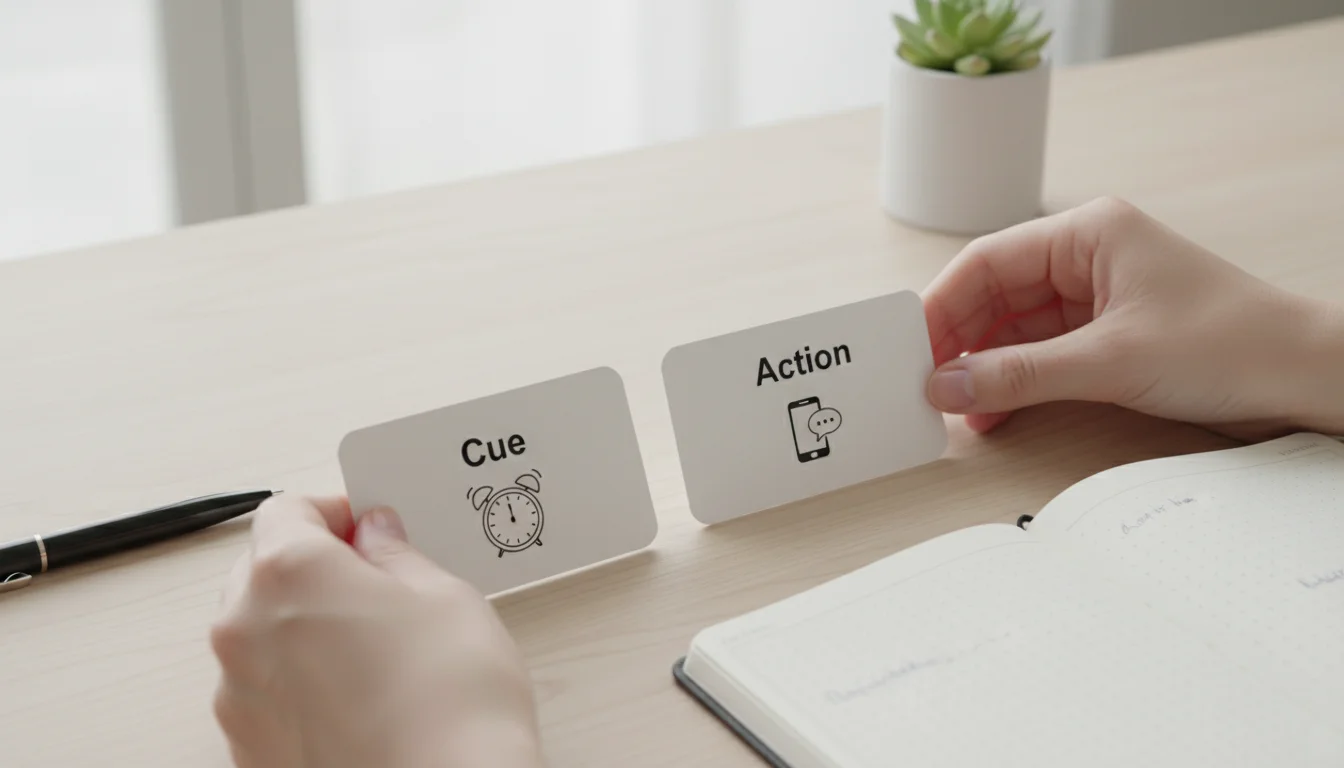
Before we can redesign our behavior, we need to understand how it works. Most of our daily actions aren’t the result of conscious thought; they’re habits running on autopilot. To change them, we need to look at the underlying mechanics. At the core of every habit is a simple neurological pattern that scientists call the habit loop. We can break it down into three simple parts:
1. The Cue: This is the trigger that tells your brain to go into automatic mode and which habit to use. It could be a time of day (7 a.m.), a location (the kitchen), an emotional state (boredom), or the action that just preceded it (finishing dinner).
2. The Action: This is the routine itself, the actual behavior you perform. It can be physical (biting your nails), mental (worrying about a project), or emotional (lashing out when stressed). This is the part we typically focus on when we think about changing a habit.
3. The Reward: This is the payoff that tells your brain, “Hey, this loop is worth remembering for the future.” The reward satisfies a craving. For a bad habit like smoking, the reward is the nicotine hit. For a good habit like exercise, it might be the flood of endorphins or a sense of accomplishment.
For example, your phone buzzes on the table (cue). You pick it up and scroll through social media (action). You get a small hit of novelty and social connection (reward). This loop is so powerful that your brain starts to crave the reward the moment it perceives the cue. Understanding this loop is the first step to hijacking it for your own benefit.

From Doing to Being: The Power of Identity-Based Habits
Now, here’s where we add a crucial layer. Many people fail because they focus only on the outcome. “I want to lose 20 pounds,” or “I want to write a novel.” These are great goals, but they are separate from who you are. A far more powerful approach is to focus on your identity. This is the concept of identity-based habits. Instead of focusing on what you want to achieve, you focus on who you wish to become.
The goal isn’t to run a marathon; it’s to become a runner. The goal isn’t to write a book; it’s to become a writer. The goal isn’t to meditate for 30 minutes a day; it’s to become a mindful person.
Every action you take is a vote for the type of person you wish to be. When you choose to go for a run, you are casting a vote for “I am a runner.” When you sit down to write one paragraph, you are casting a vote for “I am a writer.” These small wins build up evidence of your new identity. This shift is profound because it makes behavior change about embodying a new self, not just about gritting your teeth to achieve a result. It changes the internal conversation from “I have to do this” to “This is who I am.” This is the foundation upon which durable, lasting change is built.

Designing Your System for Success
With a clear understanding of the habit loop and the power of identity, we can now move from theory to practice. Building a system for success isn’t about finding the perfect app or a secret life hack. It’s about deliberately engineering your choices and your environment to make good habits the path of least resistance. This is where we introduce the idea of social accountability, but first, we need to lay the groundwork.
You might also consider habit stacking to link your new actions to established parts of your day.

Start with a Minimum Viable Action
One of the most common mistakes is starting too big. We overestimate our future motivation and underestimate the friction of a new behavior. The solution is the Minimum Viable Action (MVA). This is the smallest, most laughably easy version of your desired habit—an action so simple you can’t say no to it. It’s the “two-minute rule” in practice.
- “Read more” becomes “Read one page.”
- “Go to the gym three times a week” becomes “Put on your workout clothes.”
- “Write for an hour every day” becomes “Open your document and write one sentence.”
The MVA is not about the result; it’s about mastering the art of showing up. It casts that initial vote for your new identity. Anyone can put on their workout clothes. Anyone can write one sentence. By making the barrier to entry almost zero, you make it easy to be consistent. And consistency is what forges a habit, not intensity.

Conduct a Friction Audit
Every action has a certain amount of friction associated with it—the effort required to perform it. Your job as a habit designer is to decrease the friction for your desired habits and increase it for your undesired ones. This is a friction audit.
To build a gym habit, you can decrease friction by packing your gym bag the night before and placing it by the door. You’ve removed the decision-making and searching that would normally slow you down. To reduce your junk food habit, you can increase friction by not keeping it in the house. If you have to get in the car and drive to the store to get a cookie, you’re far less likely to do it.
Take a few minutes to think about your MVA. What are the small obstacles that stand in your way? How can you remove them? Conversely, what makes your bad habits so easy? How can you add a step or two to make them less convenient? Environment design is one of the most effective forms of behavior change because it works even when you’re tired and unmotivated.

The Power of Social Accountability for Habits
This is the keystone of our system. Humans are social creatures. For millennia, our survival has depended on belonging to a tribe. We are deeply, biologically wired to care about what others think of us. While this can sometimes lead to negative peer pressure, we can consciously harness this force for good. When you use social pressure to get things done, you are leveraging one of the most powerful motivators known to humanity.
Social accountability is the simple act of sharing your goals and progress with another person or a group. It introduces a gentle, external pressure that makes you more likely to follow through. Knowing that someone else is aware of your commitment—and might ask you about it—is often the push you need to take action on a day when you’d rather not.
There are several ways to implement social accountability:
1. The Accountability Partner: Find one trusted friend and agree to check in with each other. This is not about judgment or shame. A good partner is a cheerleader. You can send a simple text each day: “Did my MVA!” or “Ran my mile.” The reciprocity is key; you are both in it together, supporting each other’s growth.
2. The Small Group: This could be a “mastermind” or just a group chat with 3-4 friends who share similar goals. A weekly check-in can be incredibly powerful. Sharing both your wins and your struggles in a safe space creates a strong sense of camaraderie and shared purpose.
3. The Public Declaration (with caution): Sharing your goal on social media can be effective, but it comes with a risk. Sometimes, the praise you get for simply announcing a goal can satisfy the brain’s need for reward, making you less likely to do the actual work. If you go this route, focus on sharing your process and progress, not just the initial declaration.
4. The Coach or Mentor: For high-stakes goals, investing in a coach is the ultimate form of social accountability. The financial commitment and scheduled check-ins create a powerful structure for success.
The key is to choose a method that feels supportive, not stressful. The goal is encouragement, not enforcement. When you combine a Minimum Viable Action with a frictionless environment and the gentle expectation of a friend, you create a system that is incredibly resilient to the ups and downs of daily motivation.

Building Safeguards: How to Be Resilient When You Slip
Perfection is not the goal. Consistency is. Even with the best system in the world, you will have off days. Life is unpredictable. You will get sick, you will travel, you will be overwhelmed. The difference between people who build lasting habits and those who don’t is not that they never fail; it’s how they respond to failure.
Learning how to make your habits habit-proof is essential for maintaining momentum when your schedule becomes unpredictable.

Plan for Relapse Before It Happens
Instead of hoping you’ll never miss a day, plan for it. This is called relapse planning. For your chosen habit, ask yourself: “What are the most likely obstacles that will get in my way?” and “When I miss a day, what is my plan to get back on track immediately?”
For example, if your habit is a morning run, an obstacle might be a rainy day. Your plan could be a 15-minute indoor workout video. Another obstacle might be oversleeping. Your plan could be to do your run in the evening instead. Having a pre-made plan removes the need to make a decision in a moment of weakness or frustration. You simply follow the protocol you created when you were calm and rational.
The most important rule is this: never miss twice. Missing one day is an accident. Missing two days is the start of a new, undesirable habit. This single guideline can be the anchor that keeps you from letting a small slip turn into a complete slide. If you miss your morning meditation, make sure you do it that afternoon, even if it’s just for 60 seconds. The goal is to reinforce your identity and get back on track as quickly as possible.

The Psychology of Streaks (and Their Danger)
Tracking your progress with a streak—marking an ‘X’ on a calendar for every day you complete your habit—can be a powerful motivator. It creates a visual representation of your consistency and can be very rewarding. The longer the chain of X’s, the more you want to protect it. This is a great way to build initial momentum.
However, streaks have a dark side. When your identity gets too wrapped up in the number, breaking the streak can feel catastrophic. It can trigger the “what the hell” effect, where you feel like all your progress is lost, so you might as well give up entirely. “I already broke my 100-day streak of no sugar, so I might as well eat this entire cake.”
Use streaks as a tool, but don’t let them become your master. Your identity is “I am a person who eats healthy,” not “I am a person who has a 100-day sugar-free streak.” The streak is evidence of the identity, not the identity itself. When a streak breaks, view it as a data point, not a moral failing. What happened? What can you learn? Then, start a new streak of one, immediately.

Resetting Without Shame
This is perhaps the most critical skill in long-term behavior change: self-compassion. The voice in your head will likely be your harshest critic. When you slip up, it might say, “See? You always do this. You have no self-discipline.” This kind of negative self-talk is demotivating and counterproductive.
Instead, treat yourself as you would treat a good friend who is trying their best. You would be encouraging. You would be kind. You would remind them of how far they’ve come and help them figure out how to take the next small step. Speak to yourself in the same way. Acknowledge the frustration, but don’t dwell in it. Shame keeps you stuck. Compassion allows you to reset and begin again.
Every single day is a new opportunity to cast a vote for the person you want to become. The past does not have to dictate the future. You missed your habit yesterday? That’s okay. Today is a new day. What is the Minimum Viable Action you can take right now to get back on track? Focus on that, and only that.

Putting It All Together: Two Worked Examples
Let’s see how these principles come together in real-world scenarios. We’ll design two simple but powerful routines, one for the evening and one for the morning, incorporating all the elements we’ve discussed.

Example 1: The Evening Wind-Down Routine
Goal: To improve sleep quality by reducing evening screen time and creating a calming pre-sleep ritual.
Identity: “I am a person who prioritizes rest and recovery.”
The Plan:
Let’s imagine your current habit loop. The cue is finishing dinner and cleaning the kitchen, around 8:30 p.m. The action is to sink onto the couch and scroll through your phone or watch television for two hours. The reward is a sense of numb distraction from the day’s stress. We’re not going to fight this; we’re going to redirect it.
First, we’ll design the new environment. We conduct a friction audit. To increase friction for the old habit, you could set a “downtime” on your phone that locks social media apps after 9 p.m. You could leave the TV remote in a drawer in another room. To decrease friction for the new habit, you can create a “wind-down station” next to your favorite chair: a book you’re excited to read, a journal and pen, and a box of herbal tea.
Next, the new routine. The cue remains the same: finishing the dinner cleanup. The new Minimum Viable Action (MVA) isn’t to read for an hour and journal three pages. It’s simply to make a cup of herbal tea and sit in your wind-down chair for two minutes without your phone. That’s it. It’s so easy you can’t say no. On most nights, you’ll naturally stay longer, read a few pages, or jot down a thought, but the only requirement is those two minutes.
Finally, we add social accountability. You text a friend, your “accountability partner,” whose goal is similar. At 9 p.m., you both agree to text each other a simple message: “Winding down.” It’s not a long conversation. It’s a simple, gentle check-in that reinforces your commitment. The knowledge that your friend is expecting that text can be the tiny nudge you need to put down your phone and pick up your teacup. The new reward becomes the feeling of calm, the satisfaction of keeping a promise to yourself, and the quiet connection with your friend.

Example 2: The Morning Focus Primer
Goal: To start the workday with proactive intention instead of reactive chaos.
Identity: “I am a person who is focused and in control of my day.”
The Plan:
The common, problematic loop: The cue is your alarm going off. The action is to grab your phone from the nightstand and immediately start checking emails and news, flooding your brain with other people’s priorities before you’re even fully awake. The reward is a hit of cortisol-fueled urgency and a false sense of being “on top of things.”
Let’s re-engineer this. The friction audit is crucial. The single most effective change is to increase friction for the old habit: charge your phone in another room overnight. This one change breaks the old loop completely. To decrease friction for the new habit, place a notepad and pen right where your phone used to be. The cue is still the alarm, but now when you reach over, you find the notepad, not your phone.
The new Minimum Viable Action (MVA) is not to plan your entire day in meticulous detail. It is to simply write down your single Most Important Thing (MIT) for the day. What is the one task that, if completed, will make you feel accomplished? It takes less than 60 seconds. This small act primes your brain to focus on your own priorities first.
For social accountability for habits like this, a shared document can work wonders. You and a coworker or a partner could have a shared Google Doc titled “Daily MITs.” Before 9 a.m. each day, you both commit to writing your one MIT in the document. It’s a passive but powerful form of accountability. You see their entry, they see yours. It fosters a sense of shared focus and encourages you to be decisive about your priorities. The new reward is a feeling of clarity, control, and purpose as you begin your workday, a stark contrast to the reactive anxiety of the old routine.

Frequently Asked Questions
As you begin to implement these strategies, questions will naturally arise. Here are answers to some of the most common ones we hear from our community at TheFocusedMethod.com.
How long does it really take to form a new habit?
You’ve probably heard the number “21 days.” Unfortunately, this is a myth based on a misinterpretation of an old study. The reality, according to research, is that it can take anywhere from 18 to 254 days for a new behavior to become automatic. The average is around 66 days. But honestly, the number doesn’t matter. Fixating on a timeline can be counterproductive, leading to frustration if you don’t feel “done” by a certain date. The real goal is not to reach an endpoint where the habit is “formed,” but to embrace the process of showing up every day. Focus on your MVA, the “never miss twice” rule, and casting a vote for your new identity. The automaticity will come as a byproduct of your consistency, not as a finish line you have to race towards.
What should I do on days when my schedule is completely disrupted, like when I’m traveling?
Disruptions are a major reason why habits fail, but they don’t have to be. The key is to plan ahead and have a “disruption version” of your habit. Remember, the goal is to maintain your identity, even if the action is scaled down. If your habit is a 30-minute workout at your local gym, your travel MVA might be “do 10 push-ups and 20 squats in my hotel room.” If your habit is to write 500 words, your travel MVA might be “write one paragraph on my phone’s notes app.” The action itself is less important than the act of reinforcing the habit loop and telling yourself, “Even when things are chaotic, I am still a person who exercises/writes.” It keeps the thread of consistency alive, making it much easier to return to your full routine when your schedule normalizes.
I’ve been consistent for a while, but I’ve hit a plateau. What’s going on?
Plateaus are a completely normal part of any growth process. First, acknowledge your progress! The fact that you’ve been consistent enough to reach a plateau is a victory in itself. Plateaus can happen for a few reasons. Sometimes, the reward becomes less potent, and boredom sets in. If this is the case, consider adding a small element of novelty. If you’re a runner, try a new route. If you meditate, try a different type of guided meditation. Other times, a plateau is a sign that you’re ready for the next level of challenge. If your MVA of “put on your workout clothes” has become automatic, maybe it’s time to upgrade it to “do a 5-minute warm-up.” The key is to make a small, incremental adjustment. Don’t jump from a 2-minute habit to a 60-minute one. Make the next step just a little bit more challenging to keep yourself engaged without overwhelming your system.
Can I try to build multiple new habits at the same time?
While it’s tempting to overhaul your life all at once, we strongly advise against it. Remember that your willpower and decision-making energy are finite. Trying to build several new habits simultaneously divides your focus and drains your battery much faster, increasing the likelihood that you’ll abandon all of them. The best strategy is to focus on one single keystone habit at a time. A keystone habit is a foundational habit that tends to cause a positive ripple effect in other areas of your life (exercise and meditation are classic examples). Pour all your energy into making that one habit consistent using an MVA, friction audits, and social accountability. Once that behavior starts to feel more automatic, you can then “stack” a new habit onto it. For example, “After my morning meditation (established habit), I will write one sentence in my journal (new habit).” This method, known as habit stacking, uses the momentum of an existing habit to launch a new one, which is far more effective than starting multiple habits from a dead stop.
Where can I find more evidence-based information on habit formation?
For those interested in the science behind behavior change, an excellent, credible resource is the National Institutes of Health (NIH). Their website provides extensive information on health, wellness, and the psychology of behavior. You can visit their homepage at https://www.nih.gov. Another trusted source for information on human psychology and behavior is the American Psychological Association, which can be found at https://www.apa.org. These organizations provide a wealth of research-backed insights that support the principles discussed in this article.

Your First Steps for the Next Month
Reading about change is inspiring, but taking action is what transforms your life. This isn’t about a massive, intimidating overhaul. It’s about taking small, deliberate, and sustainable steps, supported by the power of social connection. Here are a few concrete actions you can take over the next 7 to 30 days to begin building your system.
1. Choose One Thing. For the next week, resist the urge to change everything. Pick one single area of your life you want to improve. Is it your health? Your focus? Your relationships? Now, frame it as an identity. Not “I want to exercise,” but “I want to become a person who is strong and energetic.” Write this identity down where you can see it every day.
2. Define Your Minimum Viable Action (MVA). Based on your new identity, what is the smallest possible action you can take to cast a vote for it? Make it so easy it feels ridiculous. “Read one page.” “Do one push-up.” “Tidy one surface for one minute.” This is your only goal for the next two weeks: to perform this tiny action every single day. The point is not the outcome; it’s the consistency.
3. Send One Text. This is your social accountability call to action. Think of one person in your life who is supportive and non-judgmental. Send them a message today. It can be simple: “Hey, I’m trying to build a new habit of [your MVA] to become [your identity]. Would you be willing to be my accountability partner? All we’d have to do is send a quick text each day to check in.” Taking this step makes your goal real and immediately increases your chances of success.
4. Audit Your Environment. Sometime in the next few days, take 15 minutes to perform a friction audit. How can you make your MVA easier? Put the book on your pillow. Lay your workout clothes out. How can you make the competing bad habit harder? Hide the junk food. Move the TV remote. Make one or two small changes to your physical space that will nudge you toward your desired action.
This is not a race. It is a gentle, methodical process of becoming. By focusing on a single, tiny action, engineering your environment, and leaning on the support of others, you can create a system that doesn’t require heroic willpower. You can build habits that last, not because you force them, but because they become a natural part of who you are. Start small, be kind to yourself, and just begin.
Disclaimer: The information provided in this article is for informational purposes only and is not intended as a substitute for professional medical or psychological advice, diagnosis, or treatment. Always seek the advice of your physician or other qualified health provider with any questions you may have regarding a medical or mental health condition.
Mastering the ability to recover from missed days is the secret to ensuring a temporary lapse doesn’t become a permanent stop.









Leave a Reply