
Stress often feels like an unpredictable force, an external pressure dictating your mood and productivity. Yet, much of your daily experience of stress is intimately linked to the small, repeated actions you take, or fail to take, each day. These are your habits. By systematically examining these routines, you gain control, transforming diffuse anxiety into manageable steps. This article guides you through creating a ‘habit inventory,’ a powerful tool for identifying, modifying, and building routines that actively reduce stress and cultivate a sense of steady calm in your professional and personal life.

The Habit-Stress Connection: Why Your Routines Matter
Your daily life is a complex web of repeated behaviors. Many of these actions occur on autopilot, outside your conscious awareness. These habits, whether beneficial or detrimental, significantly shape your mental state, energy levels, and overall stress resilience. Understanding this connection is the first step toward reclaiming your calm.
Consider the ripple effect of a few simple habits. Hitting snooze repeatedly can disrupt your sleep cycle, leading to morning grogginess and a rushed start. Skipping breakfast to jump straight into emails might lead to low blood sugar and irritability by mid-morning. Each seemingly small choice contributes to your overall stress load.
On the other hand, incorporating positive habits creates a buffer against stress. A morning mindfulness practice, a planned midday walk, or a structured end-of-day routine can significantly reduce perceived stress. These deliberate choices build resilience, helping you navigate challenges with greater ease. Behavioral science consistently shows that predictable routines provide a sense of control, which is a powerful antidote to anxiety.
What is a Habit Inventory for Stress Reduction?
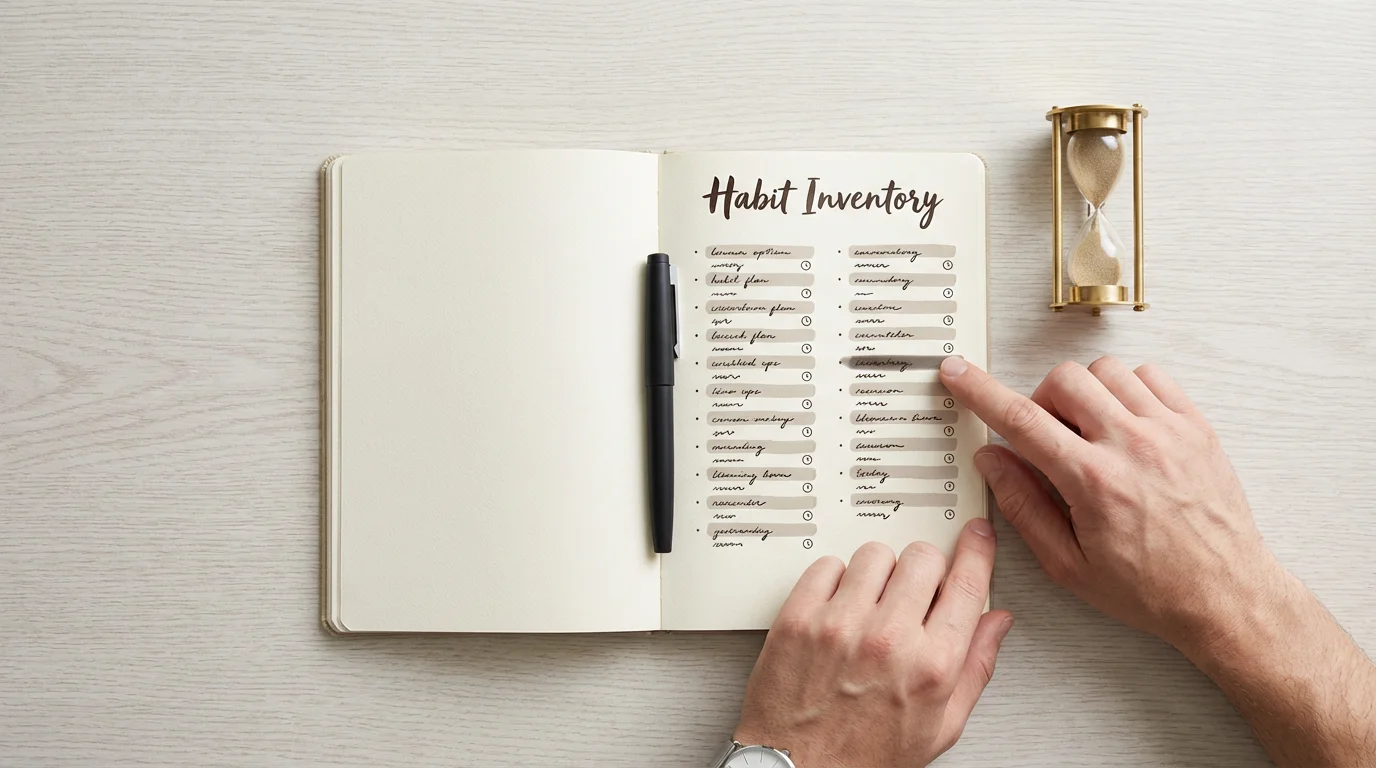
A habit inventory is a detailed, personalized list of your daily and weekly routines, analyzed specifically for their impact on your stress levels. It moves beyond simply tracking what you do, instead focusing on how each habit makes you feel and whether it contributes to or detracts from your well-being. This tool helps you see the invisible threads connecting your actions to your mental state.
You essentially become a detective of your own behavior. You observe your actions without judgment, identify the cues that trigger them, and assess their outcomes. The goal is to uncover patterns, identify opportunities for change, and build a strategic framework for cultivating stress-reducing behaviors. This process provides clarity, transforming vague feelings of being “overwhelmed” into concrete, actionable insights.

Step 1: The Daily Habit Audit – Uncovering Your Routines
The first practical step in creating your habit inventory involves a thorough audit of your current routines. This isn’t about judging yourself, but about observing your actions objectively. For a few days, preferably a typical weekday and a weekend day, simply record everything you do.
Once you have audited your daily behaviors, incorporating these findings into a structured Sunday routine can help you set a calm tone for the week ahead.
This audit often reveals that your energy levels shift throughout the day, making it easier to align your schedule with your biological prime time.
Keep a notebook or use a digital tool to log your activities. Start from the moment you wake up until you go to sleep. Be as detailed as possible, noting the time and duration of each activity. This raw data forms the foundation of your inventory.
Here’s how to conduct your daily habit audit:
- Choose Your Observation Period: Select 3-5 consecutive days, including both workdays and a weekend day, to capture a representative sample of your routines.
- Use a Simple Tracking Method: A pen and paper, a spreadsheet, or a note-taking app work well. The easier it is to log, the more consistent you will be.
- Record Everything, No Matter How Small: Document waking up, checking your phone, making coffee, commuting, attending meetings, eating, exercising, browsing social media, watching TV, and going to bed.
- Note the Time and Duration: “7:00 AM: Woke up, checked phone for 15 minutes.” “9:30 AM: Started work, immediately opened email for 30 minutes.”
- Add a Brief Context: What happened right before the habit? Who were you with? Where were you? This helps identify triggers later.
For example, a busy professional might record: “6:00 AM: Alarm. Hit snooze twice. 6:30 AM: Checked work emails in bed (15 min). 6:45 AM: Showered. 7:00 AM: Rushed breakfast (coffee only). 7:15 AM: Drove to work, listened to news radio (stressful).” This level of detail provides valuable insights into the automatic sequence of your day.

Step 2: Identify Stress Triggers and Responses in Your Habits
Once you have your list of daily habits, the next crucial step is to connect them to your emotional and physiological responses. This helps you understand which habits act as triggers for stress and which ones might be your unconscious coping mechanisms. You are looking for patterns.
By identifying the specific cues and rewards within your habit loop, you can more easily dismantle automatic stress responses.
Go through your audit notes and, next to each habit, jot down how it makes you feel immediately afterward, and also how it impacts your energy or mood later in the day. Be honest and specific about your internal experience. This self-awareness is fundamental to effective behavior change.
When reviewing your habits, ask yourself:
- What preceded this habit? Was it an internal urge, an external cue (like a notification), or a specific time of day?
- What emotional state did you experience during or after this habit? Did you feel calm, energized, rushed, frustrated, or overwhelmed?
- What physical sensations did you notice? Tense shoulders, racing heart, fatigue, or alertness?
- Did this habit lead to other habits? For instance, does checking work emails in bed lead to feeling behind before the day even starts, prompting you to skip breakfast?
- Does this habit align with your values and goals for stress reduction? Or does it pull you further away?
Consider the habit of “mindlessly scrolling social media for 20 minutes” before a deadline. You might notice a short burst of distraction, followed by increased anxiety about the impending deadline and a sense of lost time. Or, after a stressful meeting, you might habitually reach for sugary snacks, experiencing a temporary lift followed by a sugar crash and regret. These observations reveal the hidden costs of seemingly innocuous behaviors.

Step 3: Categorize Habits for Impact on Your Stress Levels
With your raw audit data and your emotional responses identified, the next step is to categorize each habit. This provides a clear, actionable overview of your current behavioral landscape. You are essentially creating a color-coded map of your routines.
For many professionals, learning how to organize your inbox is a vital step in moving a major stressor into the ‘neutral’ or managed category.
For habits specifically related to screen time or news consumption, you might find it helpful to build a weekly digital detox ritual to break the cycle of constant connectivity.
Assign each habit to one of three categories:
- Stress-Inducing Habits: These are behaviors that directly increase your stress, create feelings of overwhelm, or deplete your energy. Examples include excessive caffeine intake, constant news consumption, or procrastinating on important tasks.
- Stress-Neutral Habits: These habits have little direct impact on your stress levels. They are often necessary daily tasks that do not actively contribute to or reduce stress, such as brushing your teeth or doing laundry. While neutral, these can sometimes be opportunities for habit stacking.
- Stress-Reducing Habits: These are behaviors that actively help you manage stress, promote calm, increase energy, or contribute to your overall well-being. Examples include exercise, meditation, deep breathing, reading, or connecting with loved ones.
After categorizing, review your lists. You will likely find a surprising number of stress-inducing habits lurking in your daily routine. This categorization makes it clear where your biggest opportunities for change lie. For instance, you might realize that “checking social media first thing” (Stress-Inducing) prevents you from “doing 5 minutes of stretching” (Stress-Reducing).

Step 4: Designing Your Stress Reduction Blueprint
Now that you have a clear picture of your habits, you can start strategically designing new routines. This involves identifying which stress-inducing habits to modify or eliminate and which stress-reducing habits to introduce or strengthen. This phase is your personal behavior design workshop.
Integrating strategic micro-breaks into your blueprint can prevent tension from accumulating during high-pressure work blocks.
Focus on making small, manageable changes. Research on behavior change, such as the principles outlined by B.J. Fogg on Tiny Habits, emphasizes that small, consistent actions are far more effective than ambitious, overwhelming overhauls. Your goal is to build momentum, not perfection.
Consider these strategies for your blueprint:
- Eliminate or Replace Stress-Inducing Habits:
- Identify your top 1-2 most stress-inducing habits. Can you remove them entirely? (e.g., “stop checking work emails after 7 PM”).
- If not, can you replace them with a neutral or positive alternative? (e.g., instead of “mindlessly browsing news during lunch,” try “listening to calming music for 15 minutes”).
- Leverage Habit Stacking:
- Connect a new stress-reducing habit to an existing, well-established habit. The formula is: “After [current habit], I will [new habit].”
- Example: “After I pour my morning coffee, I will do 5 minutes of deep breathing.” Or, “After I close my laptop for the day, I will take a 10-minute walk.”
- Design Your Environment for Success:
- Make good habits easier and bad habits harder. If you want to meditate, place your meditation cushion where you will see it. If you want to reduce screen time, put your phone in another room.
- This principle, often discussed in works on creating sustainable change, significantly reduces the friction for desired behaviors.
- Start Tiny:
- If a new habit feels too big, shrink it. Instead of “meditate for 30 minutes,” start with “meditate for 1 minute.”
- The goal is to establish the routine, not to achieve peak performance on day one. Consistency builds capability over time.
- Time Blocking for Stress Reduction:
- Actively schedule your stress-reducing habits into your calendar. Treat these appointments with yourself as non-negotiable.
- Blocking 15 minutes for focused work, a 5-minute stretching break, or a half-hour for a creative hobby ensures these vital activities do not get squeezed out by other demands.
“Clarity about what matters provides clarity about what does not.” — Deep Work Principle
This principle applies directly to stress reduction. By clarifying the habits that support your calm, you also identify those that unnecessarily complicate your life. Your blueprint should clearly outline 2-3 specific changes you commit to implementing in the coming week.
For example, a marketing manager facing high work-related stress might design this blueprint:
- Modify: Instead of “checking work email first thing in bed,” the manager decides: “After I turn off my alarm, I will leave my phone charging in the kitchen and read 5 pages of a book for 10 minutes before checking any messages.”
- Stack: “After I finish my last meeting of the day, I will immediately take a 10-minute walk around the office building.”
- Introduce Tiny Habit: “Before I open my laptop for the first time each morning, I will take 3 deep, mindful breaths.”
These are small, actionable steps designed to create noticeable shifts in daily stress levels. They are not overwhelming and build upon existing routines.

Step 5: Implement, Iterate, and Adapt Your New Routines
Building new habits and modifying old ones is not a linear process. Expect challenges, setbacks, and moments where motivation wanes. The key to long-term success lies in your ability to implement your blueprint, learn from your experiences, and adapt as needed. This phase is about real-world application and continuous improvement.
To support your new routines, remember to build a habit-friendly environment that reduces friction for your positive choices.
To maintain momentum during this phase, many find success using the Seinfeld Method to ensure they never break the chain of daily practice.
Begin by focusing on just one or two changes from your blueprint. Overloading yourself with too many new habits at once often leads to abandonment. Give yourself permission to experiment and fine-tune.
Practical implementation steps:
- Start Small, Stay Consistent: Focus on making the new habit happen daily, even if imperfectly. The act of showing up is more important than the intensity of the habit initially.
- Track Your Progress: Use a simple habit tracker (a calendar, an app, or a bullet journal) to mark off each day you successfully perform your new habit. Visual progress reinforces your efforts and builds motivation.
- Schedule Reflection Time: Once a week, review your progress. What went well? What were the challenges? How did your new habits impact your stress levels?
- Adjust as Needed: If a habit feels too hard, make it smaller. If a trigger is not working, try a different one. Your blueprint is a living document, not a rigid rulebook.
- Anticipate Obstacles: Think about what might derail your new habit (e.g., unexpected meetings, travel, family demands). Develop “if-then” plans: “If I cannot take my usual midday walk, then I will do 5 minutes of stretching at my desk instead.”
- Reward Your Efforts: Acknowledge your consistency. A small, non-food reward (e.g., 10 minutes of leisure reading, a new podcast episode) can reinforce positive behavior.
Imagine the marketing manager from the previous example. After a week, they reflect: “Reading for 10 minutes before emails is great; I feel calmer. The 10-minute walk after the last meeting sometimes gets skipped if I have a late call. The deep breaths before opening the laptop are consistent.” Their iteration might be: “For the walk, if a late call happens, I will immediately do a 5-minute desk yoga routine.” This adaptive mindset ensures sustainable change.

Common Pitfalls and Overcoming Them
The journey to a less stressed life through habit change is rarely smooth. You will encounter obstacles. Recognizing common pitfalls allows you to prepare for them and respond effectively, rather than getting discouraged.
Long-term success is more likely if you use an identity-based approach, shifting your perspective to see yourself as a calm and organized professional.
Here are some frequent challenges and strategies to overcome them:
- The “All-or-Nothing” Trap:
- Pitfall: You miss a habit one day and decide the whole system is broken, giving up entirely.
- Overcome: Understand that perfection is unrealistic. Focus on consistency over time, not daily streaks. As research on consistency demonstrates, a missed day is just a data point, not a failure. Get back on track immediately.
- Overwhelm from Too Many Changes:
- Pitfall: You try to overhaul your entire routine at once, leading to exhaustion and abandonment.
- Overcome: Pick one, maybe two, habits to focus on at a time. Master them before adding more. Prioritize the habits that will have the biggest impact on your stress.
- Lack of Specificity:
- Pitfall: Your new habit is too vague (e.g., “be less stressed”).
- Overcome: Make habits concrete and measurable. Instead of “be less stressed,” try “do a 5-minute guided meditation at 8:00 AM” or “journal for 10 minutes before bed.”
- Ignoring the Environment:
- Pitfall: You try to build new habits without modifying your surroundings, making them harder to perform.
- Overcome: Actively design your environment. Leave your running shoes by the door if you want to run. Put your phone out of reach if you want to focus. Remove tempting snacks if you want to eat healthier.
- Underestimating the Power of Triggers:
- Pitfall: You focus only on the habit itself, ignoring the cues that prompt it.
- Overcome: Consciously identify and leverage triggers. Use existing habits as cues for new ones (habit stacking). Set alarms or use visual reminders for important stress-reducing actions.
- Expecting Immediate Results:
- Pitfall: You get discouraged when you do not feel instantly less stressed after a few days.
- Overcome: Recognize that habit change is a long-term investment. Stress reduction is cumulative. Celebrate small victories and trust that consistent effort will yield results over time.
By anticipating these common hurdles and having strategies in place, you increase your likelihood of success and build a more resilient approach to stress management. Remember that every step, no matter how small, moves you closer to a steadier, calmer self.
Frequently Asked Questions
How long does it take to build a new stress-reducing habit?
The time it takes varies widely for individuals and habit complexity. While some studies suggest an average of 66 days for a new behavior to become automatic, focus on consistency rather than a specific timeline. Every day you practice reinforces the neural pathways for that new habit.
What if my job demands make consistent routines impossible?
Acknowledge that flexibility is key for busy professionals. Focus on micro-habits and adaptable routines. Instead of a 30-minute meditation, try 1 minute of mindful breathing. When travel disrupts your exercise routine, aim for a 15-minute walk. The goal is small, consistent efforts, not rigid adherence.
Can a habit inventory identify sources of stress I am unaware of?
Absolutely. By meticulously logging your actions and emotional responses, you often uncover subtle patterns. You might realize that routinely checking news updates before bed, which seemed harmless, consistently increases your anxiety and disrupts sleep. The inventory brings these unconscious connections to light.
How do I stay motivated when I feel overwhelmed?
When motivation dips, revert to the “tiny habits” principle. Do the absolute minimum version of your habit. If you planned a 20-minute workout, just do 5 minutes of stretching. The aim is to maintain the streak and reinforce your identity as someone who prioritizes stress reduction, even when tired.
Is it better to eliminate bad habits or introduce good ones first?
Often, it is most effective to focus on introducing a new, positive habit that crowds out a negative one. For example, by consistently engaging in a morning stretching routine, you naturally reduce the time available for doom-scrolling. Sometimes, actively eliminating a harmful habit is necessary, but positive replacement is usually more sustainable.
What role does self-compassion play in this process?
Self-compassion is critical. Habit change involves trial and error. Instead of criticizing yourself for setbacks, approach challenges with kindness and curiosity. Understand that stress reduction is a continuous journey, and imperfections are part of the learning process. This fosters resilience and prevents burnout.
This article is for informational purposes only and does not constitute medical, psychological, or legal advice. Please consult with a qualified professional for personalized guidance and support when appropriate.









Leave a Reply