

Establishing these habits is a vital component of building a more focused and productive week overall.
📚 Table of Contents
- What Is a “Deep Work” Ritual and Why Does It Work?
- Setting Up Your Deep Work Environment and Calendar
- Your Digital Calendar: The Foundation
- Your Physical Space: The Sanctuary
- Building in Buffers and Realism
- Executing Your Ritual: A Day and a Week in Focus
- Guardrails: Handling Interruptions and Staying on Track
- When a Colleague Interrupts You
- When a Meeting Gets Dropped on Your Calendar
- When a Task Takes Longer Than Expected
- Fine-Tuning Your System: The Weekly Review
- Real-World Scenarios: Putting the Ritual into Practice
- Frequently Asked Questions About Deep Work Rituals
- How strict should I be with my time blocks?
- What if my job is mostly meetings and reactive work?
- How long does it take to build a deep work habit?
- I have ADHD. Will this work for me?
- What’s the difference between a ritual and a routine?
- Your Next Steps: Start Your Deep Work Practice This Week
You ended the day exhausted. Your calendar was a rainbow of back-to-back meetings, your inbox overflowed, and your phone buzzed with an endless stream of notifications. You were busy. But were you productive? For many busy professionals and students living in the constant hum of the city, the answer is a frustrating no. The feeling of running all day but never moving forward is all too common. You know you need to focus, but the world seems designed to steal your concentration.
Traditional, rigid time management systems often fail us because they shatter the moment real life intervenes. A surprise meeting, a traffic jam, or a project that takes longer than expected can derail the entire day. The solution isn’t more rigidity. It’s a smarter, more resilient structure. This is where a “deep work” ritual comes in. It’s not about a perfect schedule; it’s about creating a reliable process that signals to your brain it’s time to achieve meaningful focus, no matter how chaotic your environment is. This guide will show you exactly how to build a personal ritual that fits your life and helps you reclaim your most valuable asset: your attention.

What Is a “Deep Work” Ritual and Why Does It Work?
First, let’s define our core concept. The term deep work, popularized by author and professor Cal Newport, refers to professional activities performed in a state of distraction-free concentration that push your cognitive capabilities to their limit. These efforts create new value, improve your skill, and are hard to replicate. Think of writing a complex strategy document, coding a difficult feature, or studying for a final exam. It’s the opposite of “shallow work”—the logistical, non-cognitive tasks like responding to emails, scheduling meetings, and processing paperwork that we often use to feel busy.
This launch sequence is designed to help you transition into a deep flow state where your best work happens.
A ritual, in this context, is a sequence of simple, repeatable actions you perform immediately before a deep work session. It’s a launch sequence for your brain. Your ritual could be as simple as clearing your desk, putting on noise-canceling headphones, and opening a specific application. The specific steps don’t matter as much as their consistency. So, why is this combination of a ritual and deep work so effective for boosting focus and concentration?
It works because it systematically dismantles the common barriers to focus. A primary enemy of productivity is context switching. This is the mental cost you pay every time you shift your attention from one unrelated task to another, like jumping from a report to an instant message and back again. A deep work ritual creates a protective bubble, signaling to your brain and those around you that you are entering a period of dedicated focus, which minimizes these costly shifts.
Furthermore, a ritual reduces decision fatigue. When you don’t have to decide how to start, you conserve mental energy for the actual work. The ritual becomes the small, easy first step that helps you overcome the initial friction of procrastination. Over time, this process builds a powerful psychological habit. Just as an athlete has a pre-game routine, your deep work ritual trains your mind to associate a specific set of cues with a state of high concentration. It makes focus less of a struggle and more of an automatic response.

Setting Up Your Deep Work Environment and Calendar
Before you can execute your ritual, you need to prepare your tools and your space. A little bit of setup makes a world of difference. Your goal is to create an environment where the decision to do deep work is the easiest one to make. We will focus on two key areas: your digital calendar and your physical workspace.
Before diving into the logistics, it is worth asking is your environment sabotaging your focus before you even begin your session.

Your Digital Calendar: The Foundation
Your calendar is not just for meetings; it’s a blueprint for your intentions. We will use a technique called time blocking, which simply means scheduling specific blocks of time for specific tasks in advance. Instead of working from a to-do list, you are assigning every minute of your workday a job. This proactive approach prevents others from hijacking your time.
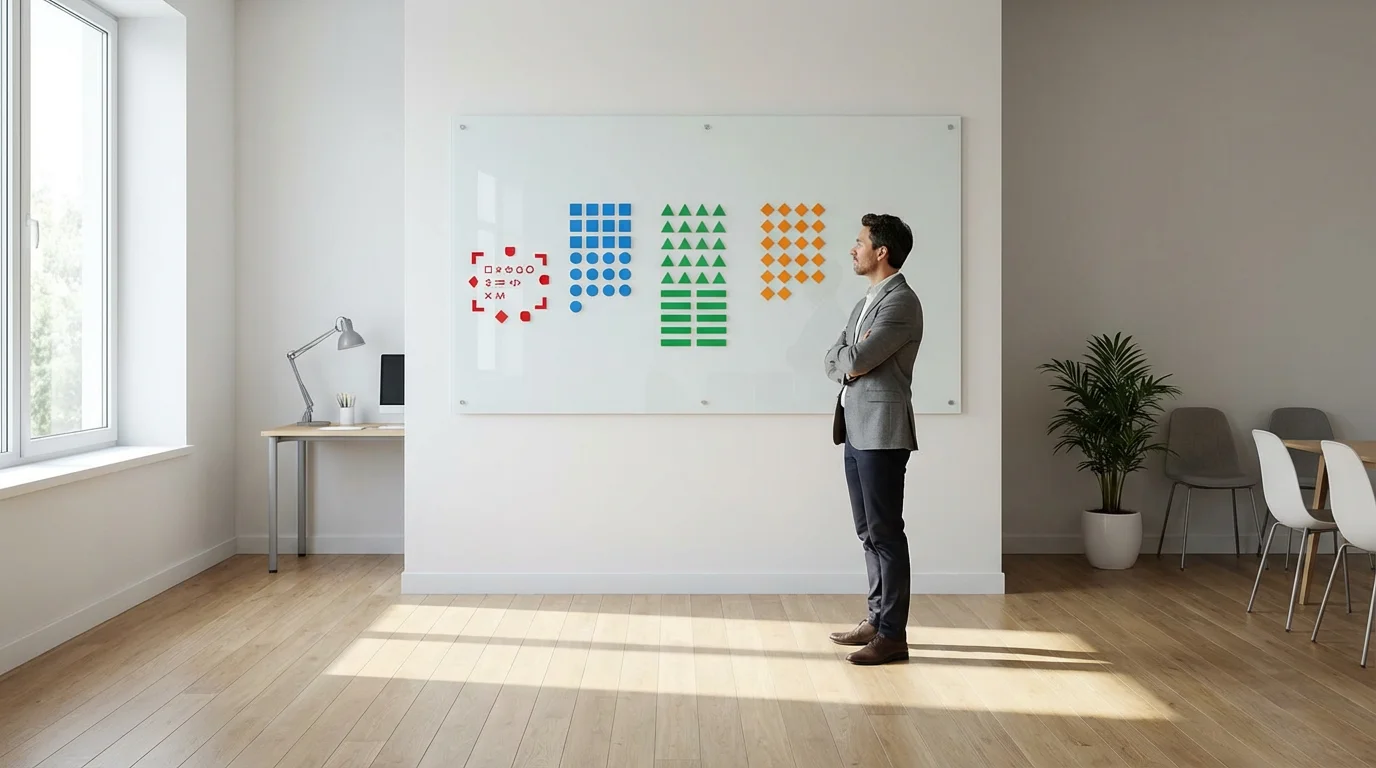
Start by setting up a simple color-coding system in your calendar app of choice, like Google Calendar or Outlook. A good starting point is:
Green for Deep Work: This color represents your most important, high-concentration tasks. It should be guarded fiercely.
Blue for Shallow Work: Use this for email, administrative tasks, and routine chores. Batching these together is highly effective.
Red for Meetings & Appointments: This helps you see your collaborative commitments at a glance.
Gray for Buffers & Transitions: This includes lunch, breaks, and commute time. Never schedule blocks back-to-back.
When you name your blocks, be specific. Instead of a vague block named “Work,” use a descriptive title like “Draft Chapter 1 of Sales Report” or “Analyze Q3 User Data.” This clarity removes any ambiguity about what you’re supposed to be doing when the time arrives.

Your Physical Space: The Sanctuary
Your physical environment sends powerful cues to your brain. If your desk is a chaotic mess of papers, coffee mugs, and clutter, your mind will feel the same. Designate a specific spot for deep work, whether it’s your desk at home, a particular corner of the office, or a quiet carrel in the library. This space should be optimized for concentration.
Your pre-session ritual should include clearing this space of all distractions. The most significant culprit is your smartphone. Put it in another room or turn it completely off. On your computer, close all unnecessary tabs and turn off notifications. Prepare everything you need beforehand: a glass of water, a notebook for stray thoughts, and any reference materials. The goal is to eliminate any reason to get up or get distracted once your session begins.

Building in Buffers and Realism
A common mistake is creating a perfectly packed schedule with no room for error. Life is unpredictable. Always schedule 15-minute buffer blocks between major tasks. This gives you time to stretch, reset, or handle a quick, unexpected issue without derailing your entire day.
This approach also helps you combat Parkinson’s Law, the adage that states, “work expands so as to fill the time available for its completion.” By assigning a specific and realistic block of time to a task—say, 90 minutes instead of an entire afternoon—you create a sense of urgency that encourages focus. You are telling yourself that this is the dedicated time to make progress, not just to sit at your desk.


Executing Your Ritual: A Day and a Week in Focus
With your calendar and environment prepared, it’s time to bring your deep work ritual to life. The key here is consistency. Let’s walk through what this looks like in practice, first on a daily level and then scaling up to a full week.
During these scheduled blocks, using the Pomodoro Technique can help you maintain intensity while preventing mental fatigue.
To ensure you have the clarity needed for these sessions, establishing a consistent Sunday routine can help you audit your upcoming priorities.

A Sample Deep Work Day
Imagine your goal is to finish a critical project proposal. Your day might look something like this:
8:30 AM (Arrival & Prep): You arrive at the office or your home workspace. Instead of immediately opening your email and reacting to the day’s demands, you take five minutes. You grab a coffee, review your color-coded calendar, and confirm that your first task is a 90-minute deep work block on the proposal.
8:55 AM (Ritual Start): You begin your pre-work ritual. You close your email tab and Slack. You put your phone in your desk drawer on silent. You put on your favorite instrumental playlist with headphones. You open the proposal document and nothing else. This three-step sequence takes less than five minutes but sends a clear signal to your brain: it’s time to focus.
9:00 AM – 10:30 AM (Deep Work Block 1): For the next 90 minutes, you give your complete, undivided attention to the proposal. When a random thought pops into your head—like “I need to email Sarah back”—you jot it down on a notepad and immediately return to the proposal. You are single-tasking at your cognitive peak.
10:30 AM – 11:00 AM (Break & Shallow Work): The calendar alert goes off. The session is over. You get up, stretch, and refill your water. Now, you can spend 20-30 minutes on shallow work. You check your email, reply to that message from Sarah, and handle any quick administrative tasks. This is a planned, controlled interaction with distractions.
11:00 AM – 12:30 PM (Deep Work Block 2): You run your ritual again and dive back into the proposal for another focused 90-minute session. The rest of your day might be filled with meetings (red blocks) and more shallow work (blue blocks), but you’ve already secured three hours of deep, meaningful progress on your most important task.
4:50 PM (Shutdown Ritual): Before you leave, you take ten minutes to review what you accomplished and plan the next day’s deep work blocks. This creates closure and ensures you start the next morning with clarity.

Scaling Up to a Full Week
To make this system truly powerful, you need a weekly perspective. Every Sunday evening or Monday morning, take 30 minutes to plan your week. First, identify your 2-3 most important goals for the week. These are your deep work candidates.
Next, open your calendar and schedule your deep work blocks (green) first. Treat them like your most important appointments. Protect your peak energy hours—if you’re sharpest in the morning, block off 9 AM to 11 AM every day. Then, schedule your meetings (red) and batch your shallow work (blue) into specific, consolidated blocks. For example, have an “Email Hour” at 11 AM and 4 PM instead of checking it constantly.
This method helps you apply the 80/20 Principle, also known as the Pareto Principle. This concept suggests that for many outcomes, roughly 80% of consequences come from 20% of the causes. By identifying and dedicating your best energy to the few tasks that drive the most results (your deep work), you ensure you are always working on what truly matters.


Guardrails: Handling Interruptions and Staying on Track
No system is perfect, and the modern workplace is full of unpredictable demands. The strength of a deep work ritual lies not in its rigidity but in its resilience. Here is how to pragmatically handle the inevitable interruptions, overruns, and unexpected requests that threaten your focus.
Developing the ability to say no to non-essential requests is a fundamental skill for maintaining your deep work boundaries.

When a Colleague Interrupts You
It’s bound to happen. A coworker walks up to your desk with a “quick question” right in the middle of your deep work block. The key is to be polite but firm. Having headphones on is a powerful universal signal for “do not disturb.”
If someone does break through, have a script ready. You can say something like, “I’d love to help with that. I’m in the middle of a focus session right now to meet a deadline. Can I swing by your desk in 45 minutes when my block is finished?” This respects their need while protecting your commitment. It renegotiates the timeline without being dismissive.

When a Meeting Gets Dropped on Your Calendar
Your calendar should be a fortress you command, not a public space anyone can occupy. When a meeting invitation appears on top of a scheduled deep work block, don’t automatically accept. First, assess its importance. Do you need to be there? Is there a clear agenda? Could the goal be accomplished via email?
If the meeting is necessary, see if you can negotiate the time. A simple reply can work wonders: “Thanks for the invite. I’m scheduled to complete the Q3 data analysis during that time, which is a key dependency for our team goal. Would it be possible to move this to the afternoon?” This frames your deep work as what it is: a critical, non-negotiable task, just like a meeting with a client.

When a Task Takes Longer Than Expected
You scheduled 90 minutes for a task, but you’re only halfway through when the timer goes off. This is not a failure; it’s a data point. This is where the concept of timeboxing is useful. Timeboxing means you allocate a fixed time period, or “box,” to an activity. When the time is up, you pause and assess.
You have a few options. You can decide to extend the block by another 30 minutes if you have the flexibility and are in a state of flow. Alternatively, you can stop, make a note of where you left off, and schedule a new deep work block for it later in the day or the next. Or, you might realize the task was much larger than you anticipated, and you need to break it down into smaller, more manageable sub-tasks. The timebox forces a moment of reflection instead of allowing you to drift aimlessly on a single task for hours.


Fine-Tuning Your System: The Weekly Review
A deep work practice is not a “set it and forget it” system. It’s a dynamic process that needs to be adjusted as your priorities and energy levels change. The most important habit you can build alongside your deep work ritual is the weekly review. This is your dedicated time to step back, see what’s working, and identify what needs to be tweaked.
Schedule a 30-minute block for yourself every Friday afternoon. Treat it as a mandatory appointment. During this time, look back at your calendar from the past week and ask yourself a few simple questions.
What to Ask Yourself
How many deep work sessions did I plan, and how many did I complete? The goal isn’t 100% perfection, but a high completion rate shows the system is working. If there’s a big gap, what caused it? Were there too many meetings, or were you too optimistic?
What were my biggest distractions? Be honest. Was it a specific person, a particular app, or your own thoughts? Once you name the distraction, you can devise a strategy to mitigate it next week.
When was my energy highest and lowest? Look for patterns. You might discover you’re a focus machine from 9 AM to 11 AM but can barely concentrate after 3 PM. This is valuable data. Adjust your schedule next week to align your most important deep work with your peak energy windows. Good energy is often tied to overall wellness, including sleep. For evidence-based information on sleep hygiene, resources like the Sleep Foundation can be very helpful.
How many tasks “rolled over” to the next day? A high rollover rate is a sign that you are underestimating how long tasks take. Start building in more generous time blocks or breaking large projects into smaller pieces.

Metrics to Watch
Over time, you can track a few simple metrics to see your progress:
Deep Work Count: A simple tally of your completed deep work blocks per week. Aim to increase this number gradually or maintain a consistent, sustainable level.
Energy Level Correlation: A qualitative measure. Note down a simple energy score (1-5) for each day. You’ll soon see what habits and schedules lead to high-energy, high-focus days.
Rollover Rate: The percentage of tasks planned for a day that had to be moved. A decreasing rate shows your planning and estimation skills are improving.


Real-World Scenarios: Putting the Ritual into Practice
The principles of a deep work ritual are universal, but their application is highly personal. Let’s look at how two different people in very different situations might implement this system.
Applying these concepts in a home environment is easier when you follow best practices for working from home to maintain work-life balance.

Scenario 1: The Hybrid Professional (Maria)
Challenge: Maria is a marketing manager who works from home two days a week (Tuesday and Thursday) and is in the office the other three. Her in-office days are packed with collaborative meetings and team check-ins, while her remote days are constantly interrupted by home life and a deluge of chat messages.
Her Deep Work Ritual and System: Maria decides to strategically design her week around her hybrid schedule. She designates her remote days as her primary “deep work days.” On Monday, during her weekly review, she identifies her two biggest projects for the week: writing a creative brief and analyzing campaign data. She blocks off two 2-hour deep work sessions on both Tuesday and Thursday to tackle these tasks.
Her at-home ritual is specific: she “commutes” to her home office by taking a 10-minute walk outside. When she returns, she puts her phone in a basket in the living room, starts her “Focus” playlist, and tells her family she’s in a work block. Her in-office days are intentionally scheduled for meetings, brainstorming sessions, and shallow work like expense reports. By separating the *type* of work based on her *location*, she creates clear boundaries and expectations for herself and her team, maximizing her ability to achieve deep concentration when she needs it most.

Scenario 2: The University Student (Leo)
Challenge: Leo is a full-time engineering student with a fragmented schedule of classes, labs, and a part-time job. He struggles to find long, uninterrupted stretches of time to study complex subjects and often ends up cramming late at night.
His Deep Work Ritual and System: Leo can’t block off a full morning, but his schedule is full of 60-to-90-minute gaps between classes. He decides to turn these gaps into focused study sessions. He identifies the university library’s quietest floor as his “deep work sanctuary.”
His ritual is simple and portable. When he arrives at the library, he finds an empty carrel, puts his phone in his backpack on airplane mode, puts on noise-canceling headphones (even without music), and opens only the textbook and notebook for one specific subject. He uses timeboxing, setting a 50-minute timer to study for his physics class. When the timer goes off, he takes a 10-minute break to walk around before starting another 50-minute block on a different subject. This prevents mental fatigue and helps him make steady, consistent progress on all his courses without feeling overwhelmed. He has stopped trying to find the “perfect” four-hour study block and instead maximizes the small windows of time he already has.

Frequently Asked Questions About Deep Work Rituals
How strict should I be with my time blocks?
Think of your time blocks as a guide, not a cage. The primary goal is to be intentional with your time. If you are in a state of flow and need an extra 15 minutes to finish a thought, take it. Conversely, if you finish a task early, feel free to take a longer break or move on to the next item. The ritual is about making it easy to start and maintain focus; the schedule itself should be flexible enough to accommodate the natural rhythm of your work.
What if my job is mostly meetings and reactive work?
This is a common challenge, especially for managers or those in client-facing roles. Even in a reactive environment, you can likely find small pockets for deep work. Start by looking for just one 60-minute slot in your day. Is it first thing in the morning before the meetings begin? Or perhaps a quiet hour late in the afternoon? Block this time and protect it as fiercely as you would a meeting with your CEO. Even one hour of uninterrupted, deep work can produce a surprising amount of value and can have a massive impact on your sense of accomplishment.
How long does it take to build a deep work habit?
Building any new habit takes time and patience. There is no magic number, but research suggests it can take anywhere from a few weeks to several months for a new behavior to become automatic. The key is consistency, not perfection. Focus on successfully completing your ritual and one deep work block each day. Some days will be better than others. As noted by organizations like the American Psychological Association, self-compassion and persistence are crucial for habit formation. Celebrate the small wins and don’t get discouraged if you have an off day.
I have ADHD. Will this work for me?
While this is not medical advice, many individuals with ADHD find that external structure is incredibly helpful for managing attention. A deep work ritual can provide the scaffolding needed to initiate tasks, which is often a major hurdle. You may want to experiment with shorter work blocks, such as the Pomodoro Technique (e.g., 25-45 minutes of focus followed by a 5-minute break). The structure of timeboxing can also be beneficial, as it provides a clear endpoint and prevents hyperfocus on one task to the detriment of others. The key is to adapt the system to what works for your unique brain. For more information on attention and focus, a great resource is the National Institutes of Health (NIH).
What’s the difference between a ritual and a routine?
These terms are often used interchangeably, but there’s a subtle and important difference in this context. A routine can sometimes feel like a mindless chore you have to get through, like brushing your teeth. A ritual, on the other hand, is infused with intention and purpose. It is a deliberate, mindful practice designed to shift your mental state. Your deep work ritual isn’t just a checklist of actions; it’s a conscious transition from a state of distraction and reactivity to one of profound focus and concentration.


Your Next Steps: Start Your Deep Work Practice This Week
Reading about deep work is one thing; doing it is another. The key to building this skill is to start small and build momentum. Don’t try to overhaul your entire life overnight. Instead, take a few simple, concrete actions this week to begin creating your own deep work ritual.
For more strategies on organizing your schedule, explore your complete guide to a more focused and productive week.
1. Identify Your Most Important Task. Look at your week ahead and ask: What is the one thing that, if I completed it, would be a major win? This could be a project, a paper, or an important piece of analysis. This is your first deep work candidate.
2. Schedule One 90-Minute Block. Open your calendar right now. Find a 90-minute slot in the next two days. Create an event, name it after your most important task, and color-code it. Treat this appointment as non-negotiable.
3. Design a Simple 3-Step Ritual. Don’t overcomplicate it. Your starting ritual can be incredibly simple. For example: 1) Close all browser tabs except the one you need. 2) Put your phone on silent and move it out of arm’s reach. 3) Set a timer for 90 minutes. That’s it. Write these three steps down on a sticky note.
4. Execute and Observe. When your scheduled block arrives, perform your three-step ritual and begin working. Don’t worry about being perfectly focused. Just show up and honor the time you set aside. When the timer goes off, notice how you feel. You’ve just taken the first and most important step toward reclaiming your focus.
By consistently practicing this simple loop—planning, creating a ritual, and executing—you will steadily build the mental muscle required for deep, meaningful work. You will trade the feeling of being busy for the satisfaction of being truly productive.
Disclaimer: The information provided in this article is for educational and informational purposes only and is not intended as a substitute for professional medical or psychological advice. Always seek the advice of a qualified health provider with any questions you may have regarding a medical condition.






Leave a Reply