


Moving from chaos to clarity often starts with learning how to use your digital calendar like a pro to support your new habits.
📚 Table of Contents
- Sign #1: You Live in “Reactive Mode”
- Sign #2: Your Big Goals Never Make It Onto Your Calendar
- Sign #3: You Consistently Underestimate How Long Tasks Take
- Sign #4: Your Energy Crashes by 3 PM
- Sign #5: “Quick Tasks” Devour Your Entire Day
- Putting It All Together: Your New Calendar Setup
- Building Guardrails: How to Handle Real Life
- Two Scenarios: The Focused Method in Action
- Frequently Asked Questions (FAQ)
- What if my whole day is back-to-back meetings?
- How strict should my time blocks be? What if I’m not “feeling it”?
- Can I use a paper planner for this?
- How long does it take to get used to this system?
- What’s the difference between time blocking and timeboxing?
- I work in a creative field. Doesn’t this kill spontaneity?
- Your First Steps to Taking Back Your Time
You look at your calendar, and it’s a chaotic mess of overlapping meetings, vague to-do items, and hopeful reminders. You live in a bustling city, and your day feels the same—a constant stream of traffic, noise, and demands. You’re busy. You’re always moving. But are you making progress? For many busy professionals and ambitious students, the answer is a frustrating no. The constant hustle leads to burnout, not breakthroughs. You end your days feeling exhausted, looking at an even longer to-do list for tomorrow.
Many so-called productivity gurus offer advice that feels disconnected from reality. “Just wake up at 4 AM.” “Hustle harder.” “Just say no.” This advice often ignores the non-negotiable constraints of your life: the mandatory 9 AM lecture, the client who only meets in the afternoon, the commute that eats an hour of your day. You don’t need more rigidity; you need a flexible structure that works with your life, not against it.
This is where we come in. At TheFocusedMethod.com, we believe that effective time management isn’t about cramming more into your day. It’s about getting the *right* things done with less stress. It’s about creating a system that gives you control, focus, and—most importantly—time to breathe. We’re going to walk through five common time management mistakes that might be holding you back. More than just pointing out problems, we’ll give you a concrete, pragmatic plan to fix them. Let’s identify the warning signs and build a system that fits your real life.

Sign #1: You Live in “Reactive Mode”
Does this sound familiar? You start your day with a clear goal, maybe to finish that important report. But before you can even open the document, a notification pops up. An urgent email. A Slack message from your boss. A “quick question” from a colleague. Suddenly, it’s lunchtime, and you’ve spent your entire morning putting out fires and responding to other people’s priorities. You haven’t made a single bit of progress on your own.
If you aren’t sure how your day gets hijacked, conducting a strategic time audit can help pinpoint exactly where your focus is being diverted.
This is “reactive mode,” and it’s one of the most glaring signs of low productivity. When you’re reactive, your schedule is not your own. It belongs to your inbox, your team, and anyone who can grab your attention. The primary culprit here is context switching. Context switching is the mental process of shifting your focus from one unrelated task to another. Research from organizations like the American Psychological Association (APA) suggests that even brief mental blocks created by shifting between tasks can cost as much as 40 percent of someone’s productive time. Every time you switch from your report to an email and back again, you pay a mental tax. These small taxes add up, leaving you drained and unproductive.

The Fix: Proactive Time Blocking
The antidote to reactive work is proactive planning. The most effective way to do this is through a technique called Time Blocking. Time blocking is the practice of scheduling your entire day in advance, dedicating specific blocks of time to specific tasks or activities. Instead of working from a to-do list, you work from a calendar. Your calendar becomes a concrete plan for what you will do and when you will do it.
For example, instead of a to-do list item that says “Work on Q3 Report,” your calendar would have a block from 9:00 AM to 10:30 AM labeled “Deep Work: Draft Q3 Report Introduction.” This simple act transforms a vague intention into a specific commitment. You are telling yourself—and the world—that this time is reserved. By pre-allocating your time, you make deliberate decisions about your priorities *before* the day’s chaos begins. This puts you back in the driver’s seat.


Sign #2: Your Big Goals Never Make It Onto Your Calendar
You have aspirations. Maybe you want to learn a new coding language, get a certification, or start a side project. These are the important, high-impact goals that could change your career trajectory. Yet, they remain stuck on a “someday” list. The daily deluge of urgent but low-importance tasks—answering emails, attending routine meetings, filing paperwork—always seems to take precedence. The important is constantly sacrificed for the urgent.
This is one of the most insidious common time management mistakes. We are wired to respond to immediate demands, which often feel more pressing than long-term objectives. The “tyranny of the urgent” ensures that your most meaningful work is perpetually pushed to the bottom of the pile. If your most important goals don’t have a specific time and place to live on your calendar, they are unlikely to ever happen.

The Fix: The 1-3-5 Rule with Priority Blocking
To ensure your big goals get the attention they deserve, you need a system to prioritize them. A fantastic framework is the 1-3-5 Rule. The rule is simple: on any given day, assume you can realistically accomplish one big task, three medium tasks, and five small tasks. Your “big task” should be directly linked to one of your major goals.
Here’s how to combine this with time blocking. When you plan your day, the very first block you schedule should be for your “1 big thing.” This might be a 90-minute “Deep Work” session. You protect this time fiercely. It happens before you dive into email or get pulled into less critical meetings. By paying yourself first with your time, you guarantee progress on what truly matters. The medium and small tasks can then be slotted into the remaining available blocks. This approach ensures that even on the busiest days, you are chipping away at the goals that will shape your future.

Sign #3: You Consistently Underestimate How Long Tasks Take
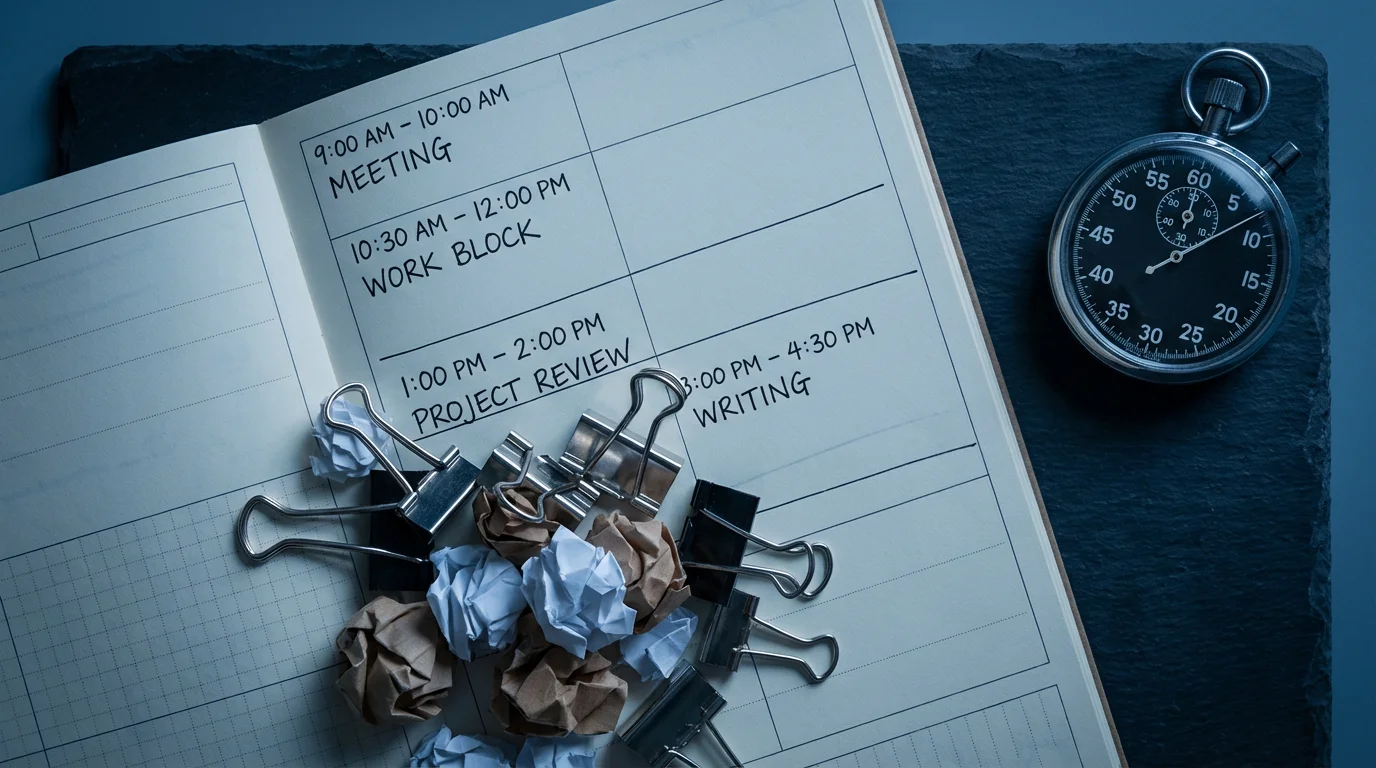
Your beautiful, color-coded calendar looks perfect at 8 AM. But by 10 AM, it’s already in shambles. The report you blocked for one hour is now stretching into its second hour. A “five-minute” phone call took thirty. This cascading failure means you spend the rest of the day playing catch-up, feeling rushed, stressed, and perpetually behind schedule. This is a classic symptom of poor time management.
This phenomenon is rooted in a cognitive bias known as the planning fallacy, where we tend to underestimate the time needed to complete a future task, even when we have experience with similar tasks taking longer. This is compounded by Parkinson’s Law, which is the adage that “work expands so as to fill the time available for its completion.” If you give yourself three hours for a task that needs one, you might find it takes three hours. But the reverse is more dangerous: if you only give yourself one hour for a task that needs two, you create stress and schedule chaos.

The Fix: Timeboxing and Strategic Buffers
The solution has two parts. First is a specific form of time blocking called Timeboxing. With timeboxing, you allocate a fixed, maximum unit of time to an activity. The key is the hard stop. You might give yourself a 25-minute timebox to clear an inbox. When the timer goes off, you stop, even if you’re not done. This forces you to focus on the highest-priority items within that box and prevents tasks from endlessly expanding.
The second, and perhaps more crucial, part is building in buffers. No schedule should be back-to-back. Life happens. A colleague stops by, a call runs long, you need a coffee. Build 15-minute buffer blocks between your main tasks. A 90-minute focus session should be followed by a 15-minute buffer before your next meeting. These buffers act as shock absorbers for your day. They give you time to wrap up, transition mentally, grab a glass of water, or absorb any overruns from the previous task without derailing your entire schedule. This is one of the most powerful productivity tips for creating a resilient, realistic plan.


Sign #4: Your Energy Crashes by 3 PM
You start the day full of energy and focus. You’re crushing your most important tasks. But after lunch, a fog rolls in. Your focus wanes, your motivation plummets, and a simple email can feel like a monumental effort. You spend the last few hours of your workday staring at the screen, accomplishing little, and feeling guilty about it. This afternoon slump is a major indicator that your time management system is ignoring a critical variable: your energy.
Maintaining high performance also requires knowing when to step away; learning how to manage your breaks is essential for preventing these mid-afternoon energy slumps.
Effective time management is not just about managing the clock; it’s about managing your energy. We are not robots. Our cognitive performance fluctuates throughout the day, influenced by our internal biological clocks, or chronotypes. According to institutions like the Sleep Foundation, understanding whether you’re a morning lark or a night owl is key to optimizing performance. Forcing yourself to do creative, high-stakes work when your brain is running on fumes is a recipe for frustration and mediocre results. Moreover, as detailed by health organizations like the National Institutes of Health (NIH), sustained mental effort without breaks leads to cognitive fatigue, reducing your ability to focus and make good decisions.

The Fix: Energy-Aware Scheduling
Start by identifying your peak energy hours. For most people, this is a 2-4 hour window in the mid-morning. This is your “prime time.” Guard this time ferociously and dedicate it exclusively to your most demanding, high-focus tasks—what we call “Deep Work.” This is when you should be working on your “1 big thing” from the 1-3-5 rule.
Conversely, identify your energy troughs, typically right after lunch or late in the afternoon. Schedule “Shallow Work” for these periods. This includes answering routine emails, filling out expense reports, scheduling meetings, or doing other low-cognitive-load tasks. By matching your task to your energy level, you work with your body’s natural rhythm instead of fighting it. Furthermore, schedule real breaks. Not just a 5-minute Twitter scroll, but a genuine disconnect. A short walk, some stretching, or a few minutes of quiet mindfulness can reset your focus and make your afternoon far more productive.


Sign #5: “Quick Tasks” Devour Your Entire Day
You sit down to work, but your day is a blur of pings and notifications. A “quick email” here, a “two-minute” Slack response there. Each of these tiny tasks seems harmless in isolation. But collectively, they are like a death by a thousand cuts for your productivity. At the end of the day, you’ve been incredibly busy, responding to dozens of stimuli, but you’ve made zero meaningful progress on your core projects. This is a common path to burnout and one of the most subtle time management mistakes.
This happens because unstructured shallow work creates constant interruptions, forcing you into a state of perpetual context switching. You never get the chance to sink into a state of deep focus. This problem is often amplified by a misunderstanding of what drives results. The 80/20 Principle, also known as the Pareto Principle, states that for many outcomes, roughly 80% of the consequences come from 20% of the causes. In productivity, this means a small number of your tasks (the 20%) generate the majority of your results (the 80%). When “quick tasks” take over, you spend all your time on the low-impact 80% of activities that yield only 20% of the results.

The Fix: Batch Your Shallow Work
The solution is to tame the chaos through Task Batching. Task batching is the method of grouping similar, small, low-effort tasks together and completing them in a single, dedicated time block. Instead of checking your email every time a notification appears, you create a “Communications Block” from 11:00 AM to 11:45 AM, and another from 4:00 PM to 4:30 PM. During these blocks, you do *only* that: process emails, respond to Slack messages, and return phone calls.
You can create batches for anything. An “Admin Batch” for filing expenses and organizing files. A “Social Media Batch” for checking and updating accounts. By containing these tasks within specific boxes, you prevent them from bleeding all over your day and interrupting your high-value work. This frees up large, uninterrupted chunks of time for the deep, focused work—the 20% of effort that will truly move the needle on your goals.


Putting It All Together: Your New Calendar Setup
Theory is great, but practical application is what matters. Let’s translate these concepts into a tangible calendar system you can start using today. This isn’t about rigid rules; it’s about a flexible framework you can adapt to your own needs.
Before you begin, consider following a visual guide on digital calendar management to ensure your workspace is optimized for focus.

The Setup: Configuring Your Calendar
Your digital calendar (like Google Calendar, Outlook, or Fantastical) is your best friend here. Start by creating categories and assigning each a color. A simple, effective setup might be:
- Blue for Deep Work: High-focus, high-value tasks. The “1” from your 1-3-5.
- Green for Shallow Work: Batched admin, email, and routine tasks. The “5s”.
- Yellow for Meetings & Appointments: Engagements with others. The “3s” might fall here.
- Red for Personal Time: Lunch, workouts, breaks, family commitments. Non-negotiable.
- Gray for Buffers & Commute: The transition time that makes your schedule resilient.
Before you even start adding tasks, block out your non-negotiables first. This includes your commute, your lunch break, and any hard-landscape appointments. Then, schedule your 15-20 minute buffers between every major block. This is the foundation upon which your productive day is built.

The Execution: A Walkthrough of a Day and a Week
Let’s imagine a typical day. You wake up and, before checking your phone, you spend 15 minutes planning your day using the 1-3-5 rule. Your “1” is to outline the new marketing proposal. You immediately create a 90-minute blue “Deep Work” block on your calendar from 9:00 AM to 10:30 AM.
Your day might look like this:
- 8:30 – 9:00 AM: Commute & Settle In (Gray)
- 9:00 – 10:30 AM: Deep Work: Outline Marketing Proposal (Blue)
- 10:30 – 10:45 AM: Buffer / Coffee Break (Gray)
- 10:45 AM – 11:30 AM: Shallow Work: Email & Slack Batch #1 (Green)
- 11:30 AM – 12:00 PM: Meeting: Project Sync (Yellow)
- 12:00 – 1:00 PM: Lunch & Walk (Red)
- 1:00 – 2:00 PM: Client Call & Prep (Yellow)
- 2:00 – 2:15 PM: Buffer (Gray)
- 2:15 – 3:45 PM: Deep Work: Data Analysis for Proposal (Blue) – Scheduled for a lower-energy period, but still important.
- 3:45 – 4:00 PM: Buffer / Stretch Break (Gray)
- 4:00 – 4:45 PM: Shallow Work: Admin Batch & Plan Tomorrow (Green)
- 4:45 – 5:15 PM: Commute (Gray)
Zooming out to the weekly view, you can see how these days connect. On Friday afternoon, you schedule a 30-minute “Weekly Review” block. During this time, you look back at what got done, what didn’t, and why. You look ahead to the next week’s major deadlines and appointments and begin sketching out your big “1-3-5” goals for each day. This review is where you optimize your system, notice patterns (like consistently underestimating travel time), and adjust your blocks for the week ahead, making your time management system smarter every week.


Building Guardrails: How to Handle Real Life
A plan is only useful if it can survive contact with reality. Your day will be full of interruptions, unexpected meetings, and tasks that don’t go according to plan. A good system doesn’t break under pressure; it flexes. Here’s how to build guardrails to protect your focus.

Handling Interruptions
When a colleague stops by your desk or sends an “urgent” message while you’re in a Deep Work block, your instinct might be to stop and help. Resist it. Instead, use a “capture and continue” approach. Politely say, “I’m in the middle of something right now, can I get back to you at 11:30?” or quickly jot their request down on a notepad to address during your next shallow work block. This acknowledges their need without derailing your focus.

Managing Meetings
Meetings can be huge time sinks if managed poorly. For every meeting on your calendar, add a 15-minute block before it for prep and a 15-minute block after for debriefing and action items. The prep block ensures you arrive focused and ready to contribute. The debrief block is for immediately processing notes and assigning any new tasks that came out of the meeting, so they don’t float around in your head.

Dealing with Overruns
Tasks will inevitably take longer than you planned. This is what your buffers are for. If your 90-minute block for writing a report runs over by 15 minutes, it eats into your buffer, not your next important meeting. If you find a certain type of task *consistently* runs over, that’s valuable data. It’s not a failure. It means you need to adjust your future time blocks for that task to be more realistic. Don’t beat yourself up; just update your estimates.

Renegotiating Commitments
Sometimes, you’re simply overcommitted. When a new, high-priority task lands on your plate, look at your calendar. It provides a visual, tangible representation of your limited time. You can now go to your manager and say, “I can absolutely get this done. Right now, I have Project X and Project Y scheduled for this week. Which one should I de-prioritize to make room for this new task?” This changes the conversation from a stressful “I can’t do it all” to a collaborative discussion about priorities.


Two Scenarios: The Focused Method in Action
Let’s see how this pragmatic approach to time management works for two different people living the fast-paced urban life.

Scenario 1: Jane, the Hybrid Worker
Jane works in marketing. She is in the office three days a week and works from home for two. Her biggest challenge is balancing collaborative in-office demands with the need for focused, creative work at home.
Her Solution: Jane themes her days. Tuesdays and Thursdays are her “in-office” days, which she fills with meetings, brainstorming sessions, and collaborative tasks. She blocks out commute time and uses her train ride for low-effort email batching. Mondays and Wednesdays are her protected “work from home” deep work days. She blocks out a three-hour “Deep Work: Content Creation” session in the morning on these days, turns off all notifications, and tells her team she is unavailable for calls. Friday is a mix, used for wrapping up weekly tasks and her crucial “Weekly Review” to plan the next week. Her color-coded calendar gives her a clear visual of where her energy and attention should be each day.

Scenario 2: Leo, the University Student
Leo is an engineering student. He juggles lectures, demanding lab sessions, a part-time job at a coffee shop, and a heavy study load. His schedule is dictated by class times, but his “free” time is often unstructured and unproductive.
His Solution: Leo uses time blocking to bring structure to his unstructured time. He treats his studies like a job. After his classes, he has a 90-minute block for “Problem Set #1” and another for “Lab Report Draft.” He schedules these in the campus library to minimize distractions. He batches his errands—like groceries and laundry—into one three-hour block on Sunday afternoon. He also proactively blocks out “Personal Time” for the gym and seeing friends. By scheduling his leisure time, he protects it from his studies and avoids guilt. His timeboxed study sessions (using a 25-minute timer) help him fight procrastination on difficult subjects, making his study time more intense and effective.

Frequently Asked Questions (FAQ)
What if my whole day is back-to-back meetings?
This is a common challenge. If you can’t change the schedule, manage the “in-between.” Even a 5-minute gap is a buffer. Use it to stand up, stretch, and mentally reset. Can you block 15 minutes before your block of meetings to prepare and 15 minutes after to process? Also, look critically at the meetings. Are they all necessary? Can any be an email? This is a great topic to bring up with your team, as they are likely feeling the same pain.
How strict should my time blocks be? What if I’m not “feeling it”?
The goal is structure, not a straitjacket. The plan is a guide, not a gospel. If you scheduled a creative task and you’re feeling analytical, it’s okay to swap it with an analysis block from later in the day. The point is to be *intentional* with the swap, not just drift into browsing social media. For low-motivation days, try timeboxing. Just commit to 25 minutes. Anyone can do 25 minutes. Often, starting is the hardest part.
Can I use a paper planner for this?
Absolutely. The principles are tool-agnostic. A good weekly planner with hourly layouts can work perfectly for time blocking. The key is that you are assigning tasks to specific time slots. The advantage of digital is the ease of moving blocks around when your day changes, but the tactile nature of paper works better for many people.
How long does it take to get used to this system?
Give it at least two to three weeks of consistent effort. The first week will feel awkward. You will underestimate times, miss things, and your plan will likely fall apart by noon. That’s normal. The goal is not perfection, but continuous improvement. Each day, you get better at estimating. Each weekly review, you get smarter about your scheduling. Stick with it.
What’s the difference between time blocking and timeboxing?
They are related but distinct. Time blocking is the general practice of assigning all your time to a task or category (e.g., 9-11 AM for “Project Alpha”). Timeboxing is a stricter version where you set a *fixed, maximum* amount of time for a task and stop when the timer goes off, regardless of completion. Timeboxing is an excellent tool to use *within* a time block to fight perfectionism and procrastination.
I work in a creative field. Doesn’t this kill spontaneity?
This is a major misconception. Structure actually *enables* creativity. When you block out a three-hour session for “Creative Exploration,” you are building a container for spontaneity to happen. You’re giving your brain the permission and uninterrupted space it needs to make connections and generate ideas. Without this protected space, your creative energy is constantly fragmented by emails and other distractions.


Your First Steps to Taking Back Your Time
Reading about productivity tips is easy. Implementing them is what creates change. You don’t need to overhaul your entire life overnight. Small, consistent steps are what lead to lasting results. Here are three simple actions you can take this week to start moving from a reactive, stressed state to a proactive, focused one.
1. Just Observe for Three Days. Before you change anything, simply track your time. Use a notebook or a simple app. For three days, write down what you’re doing and for how long. The results will probably surprise you and will provide a powerful, objective baseline of where your time is *actually* going. This is the first step toward intentionality.
2. Try a Single “Time Block Tuesday.” Don’t try to plan your entire week perfectly from the start. Pick one day—let’s call it “Time Block Tuesday”—and try to schedule it out. Use the color-coding, add buffers, and see how it feels. See what works and what doesn’t. Treat it as a low-stakes experiment. This single day will teach you more than hours of reading.
3. Schedule Your First Weekly Review. Block out 30 minutes on your calendar for this Friday afternoon. Use this time to look at your time tracking data from your observation period. Ask yourself: What was my biggest time-waster? What was my most productive block? What is the single most important thing I need to accomplish next week? Schedule a time block for that one thing right now.
Remember, the goal of The Focused Method isn’t to become a productivity robot. It’s to create a system that serves you, reduces your stress, and creates more space for the work and life you truly value. It’s about intention, not perfection. Start small, be consistent, and reclaim your time.
Disclaimer: The information provided in this article is for informational purposes only and does not constitute professional, medical, or legal advice. Please consult with a qualified professional for advice tailored to your specific situation.
If your calendar is drowning in corporate obligations, you must learn to beat meeting overload by auditing your attendance and setting clear agendas.






Leave a Reply