
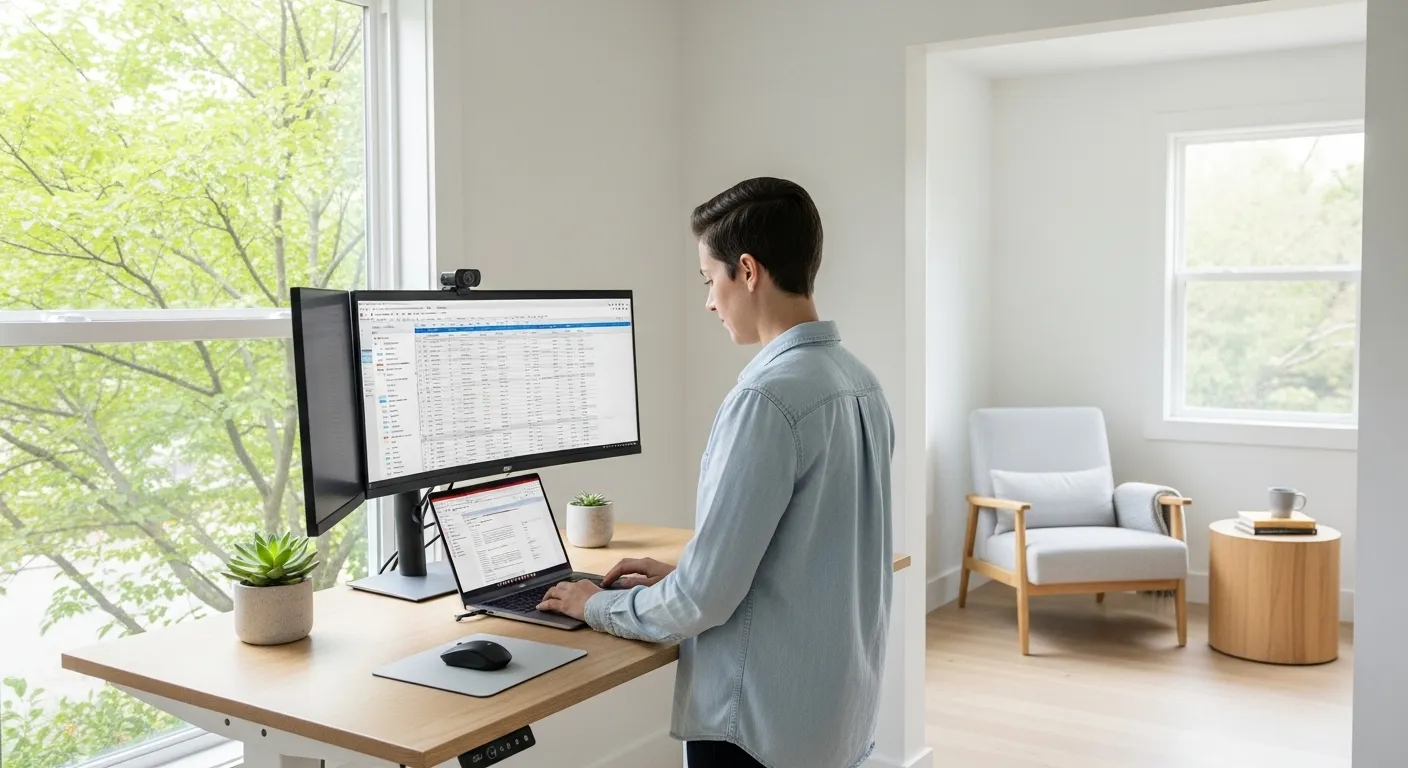
Many professionals struggle because they are still following outdated productivity myths that equate constant motion with actual achievement.
Your calendar looks like a solid wall of meetings and tasks. You jump from a video call straight into a spreadsheet, fueled by coffee and the constant pressure to do more. By 3 PM, your focus is gone, your energy is tanked, and you find yourself staring at the same paragraph for ten minutes. You’re busy, but are you productive? For most busy professionals and students living in fast-paced environments, the answer is a frustrating no.
We’ve been taught to schedule our work, our meetings, and our deadlines. But we leave the most critical component of high performance to chance: our breaks. We see them as leftover time, a luxury we earn only after the work is done. This is the single biggest mistake in modern time management. True productivity isn’t about working more hours; it’s about making the hours you work count. And that starts with reclaiming your breaks.
This is your complete break management guide. We won’t give you a rigid system that collapses the moment an unexpected meeting appears. Instead, we’ll show you how to design a flexible framework for taking productive breaks that recharge your brain, restore your focus, and build a sustainable rhythm for achieving a genuine work life balance. You will learn how to make breaks an active, intentional part of your day, turning them from wasted moments into your most powerful productivity tool.
📚 Table of Contents
- The Core Idea: Your Breaks Are Not the Absence of Work
- The Setup: Building a Break-Friendly Calendar
- 1. Create Specific Break Events
- 2. Use Color-Coding to Your Advantage
- 3. Schedule Buffer Time
- 4. Acknowledge Your Commute
- Execution: A Day and a Week in a Break-Centric Schedule
- Guardrails: Handling a World of Interruptions
- Protect Your Breaks Like Appointments
- Handle Interruptions Gracefully
- When Your Break Gets Hijacked
- Renegotiate Your Commitments
- Optimization: The Weekly Review for Sustainable Productivity
- Real-World Scenarios: Break Management in Action
- Frequently Asked Questions (FAQ)
- What if my day is just back-to-back meetings?
- How strict should I be with my break times?
- What is the best thing to do on a break?
- Is it okay to use my phone during a break?
- How is this different from the Pomodoro Technique?
- Your First Steps to Better Breaks

The Core Idea: Your Breaks Are Not the Absence of Work
Let’s reframe the entire concept of a break. A break is not an escape from work. A strategic break is a tool that enables high-quality work. Think of an elite athlete. They don’t run a marathon without water breaks or train for months without rest days. Their recovery is as planned and crucial as their performance. Your brain, the engine of your productivity, works the same way.
To get the most out of these rest periods, it helps to practice single-tasking during your work blocks to avoid mental fragmentation.
Understanding the power of pause is essential for maintaining high-level cognitive function throughout a demanding workday.
The science supports this. Your brain operates in cycles of high-frequency and low-frequency activity, known as ultradian rhythms, which last about 90 to 120 minutes. After a period of intense focus, your cognitive resources become depleted. Pushing through leads to diminished returns: more mistakes, slower thinking, and increased stress. As the American Psychological Association (APA) often highlights, chronic stress without adequate recovery is a direct path to burnout. Taking a deliberate break allows your brain to consolidate information, replenish its energy stores, and prepare for the next round of focused effort.
This is where effective break management comes in. It’s the opposite of mindlessly scrolling through your phone, which often just replaces one form of cognitive load with another. A productive break is an intentional activity designed to contrast with your work. If you stare at a screen all day, a productive break involves looking away from it. If you sit in a chair, a productive break involves moving your body. It’s about creating a rhythm of focus and rest, pulse and pause. By scheduling your breaks with the same seriousness as your most important meeting, you take control of your energy, which is the foundation of your attention.
We’ll use principles from established techniques to build our break strategy. For example, time blocking, which is dedicating specific blocks of time on your calendar for specific tasks, will be used to schedule both work and rest. We’re not just blocking work; we’re blocking recovery. This simple shift in perspective—from seeing breaks as empty space to seeing them as scheduled, essential appointments—is the first step toward unlocking a new level of productivity.

The Setup: Building a Break-Friendly Calendar
Your calendar is your command center. To make break management work, you must make your breaks visible and non-negotiable. If your breaks are just an idea in your head, they will be the first thing you sacrifice when you feel busy. Here’s how to set up your digital or physical planner for success.
Before scheduling, you might benefit from a time audit to see exactly when your energy typically dips during the day.
1. Create Specific Break Events
Don’t just block out “Break.” Be specific. Vague labels are easy to ignore. A specific label tells your brain exactly what to do, reducing decision fatigue. Create different types of break events in your calendar that you can drag and drop throughout the day.
Examples of Break Events:
Micro-Breaks (5-10 minutes): Perfect for placing between shorter tasks or back-to-back meetings.
- Name: “Stretch & Hydrate”
- Name: “Look Out Window & Breathe”
- Name: “Tidy Desk”
Recharge Breaks (15-25 minutes): Ideal after a 75-90 minute deep work session.
- Name: “Walk Around the Block (No Phone)”
- Name: “Mindful Coffee/Tea”
- Name: “Listen to 3 Songs”
Lunch & Disconnect (45-60 minutes): A crucial midday reset.
- Name: “No-Screen Lunch”
2. Use Color-Coding to Your Advantage
Visual cues are powerful. Assign a specific, calming color to all your break-related events. For example, if your work blocks are blue and meetings are red, make all your breaks green. When you glance at your day, you should instantly see a healthy pattern of green sprinkled between the red and blue. This visual feedback helps you assess your work life balance at a glance. If you see a solid wall of red, you know your day is unsustainable and needs adjustment.
3. Schedule Buffer Time
Life is unpredictable. Meetings run late and tasks take longer than expected. Build buffers around your appointments to absorb this chaos. A buffer is a small, 5 to 10-minute block of unscheduled time before or after a meeting. This buffer prevents the dreaded back-to-back schedule. It gives you time to grab water, use the restroom, or simply take three deep breaths before your next commitment. It’s a built-in micro-break that protects your sanity and your schedule.
4. Acknowledge Your Commute
If you commute to an office or campus, don’t treat that time as a productivity-hack session for answering emails. Frame it as a transitional break. Use your commute to mentally prepare for the day ahead or decompress on the way home. Listening to a podcast, an audiobook, or music can be a fantastic way to separate your work life from your home life. This is a forced break; use it wisely to create a clear boundary between different parts of your day.

Execution: A Day and a Week in a Break-Centric Schedule
Theory is one thing; practice is another. Let’s walk through what this looks like on a typical Tuesday for a busy professional.
By sticking to these scheduled blocks, you can effectively eliminate time thieves that often sabotage your focus during transition periods.
A Day in Motion:
8:45 AM – 9:00 AM: Daily Prep. You don’t jump right into emails. You review your calendar, confirm your top 1-3 priorities, and mentally prepare for your first work block.
9:00 AM – 10:30 AM: Deep Work Block 1. Ninety minutes of focused work on your most important project. All notifications are off. You are fully immersed.
10:30 AM – 10:50 AM: Recharge Break. Your calendar reminds you: “Walk Around the Block (No Phone).” You leave your desk and your phone behind. You walk outside, get some sunlight, and let your mind wander. You are not thinking about work.
10:50 AM – 11:00 AM: Buffer. You get back to your desk, grab a glass of water, and quickly glance at your notes for the upcoming meeting.
11:00 AM – 12:00 PM: Team Sync Meeting. You are present and engaged because you just had a real break.
12:00 PM – 12:30 PM: Admin Tasks. You use this shorter block for shallow work like responding to a few critical emails. This is a form of timeboxing, where you allocate a fixed time period to a task and stop when the time is up. This prevents email from expanding to fill your entire day.
12:30 PM – 1:15 PM: No-Screen Lunch. You eat your lunch away from your desk. You might chat with a colleague, read a book, or just sit quietly. This is a non-negotiable reset.
1:15 PM – 2:45 PM: Deep Work Block 2. You tackle your second major task for the day. Your energy is back up after the lunch break.
2:45 PM – 3:00 PM: Micro-Break. “Stretch & Hydrate.” You stand up, do some simple stretches, and refill your water bottle. It’s a small but effective way to break up the afternoon inertia.
3:00 PM – 5:00 PM: Collaborative Work & Meetings. The rest of the afternoon is for calls and collaboration. Between each call, you use the 5-minute gaps to stand up or look away from the screen, preventing Zoom fatigue.
A Week in Review:
Zooming out, the week has a rhythm. Monday might be heavy on deep work blocks to build momentum. Friday might have a longer lunch break scheduled to connect with colleagues or a shorter workday to ease into the weekend. The key is that the pattern of work-break-work-break remains consistent. This rhythm becomes a habit, and your brain learns to anticipate these recovery periods, allowing it to work more efficiently during the focus blocks. This is how to take effective breaks: by making them a predictable and respected part of your workflow.

Guardrails: Handling a World of Interruptions
The perfect schedule is a myth. The real world is messy. A colleague will stop by your desk, a client will call with an “urgent” request, and a meeting will run 15 minutes over, consuming your perfectly planned break. Here’s how to protect your breaks without being rigid or unhelpful.
Protect Your Breaks Like Appointments
Treat your scheduled breaks with the same respect you give a meeting with your boss. If someone tries to book over your “Recharge Break,” don’t just delete it. Propose an alternative time for their meeting. You can say, “I’m not available at 10:30, but I’m free at 11:00. Does that work?” You are not obligated to explain that your unavailability is due to a break. It’s a scheduled commitment.
Handle Interruptions Gracefully
When an unexpected interruption occurs, the goal is to minimize context switching. This is the mental cost of shifting your attention from one task to another. If a coworker asks you a question during a deep work block, it’s better to say, “I’m in the middle of something, can I find you in 30 minutes?” than to switch gears and lose your focus. If the interruption is unavoidable, make a quick note of where you left off so you can resume more easily.
When Your Break Gets Hijacked
It will happen. A meeting runs over, and your 15-minute walk is gone. Don’t just skip it. The rule is: reschedule, don’t delete. Look at your afternoon. Can you shorten a shallow work block by 15 minutes to reclaim that break? Can you take it right after the meeting, even if it’s a bit later than planned? The act of rescheduling reinforces the value of the break and prevents one disruption from derailing your entire day. A hijacked break is a debt that your schedule owes you, and you should aim to collect it before the day is over.
Renegotiate Your Commitments
Sometimes your day is simply overbooked from the start. This is often a result of what’s known as Parkinson’s Law: work expands to fill the time allotted for its completion. If you have eight hours, you’ll find eight hours of things to do. The solution is to be ruthless about your priorities. Be willing to look at your schedule and ask, “What on this list can be delegated, delayed, or deleted?” Protecting your breaks sometimes means saying no or renegotiating deadlines on lower-priority tasks. It’s better to do three important things well, with proper rest, than to do ten things poorly in a state of exhaustion.

Optimization: The Weekly Review for Sustainable Productivity
A schedule is not a static document; it’s a living experiment. To ensure your break management system is working for you, you need a feedback loop. The weekly review is a 30-minute appointment you make with yourself every Friday afternoon to look back, assess what worked, and plan for the week ahead.
How to Conduct a Weekly Review
Look at your past week’s calendar. Don’t just focus on what you got done. Ask yourself three simple questions and jot down the answers:
- What went well? Did scheduling a walk after that long strategy meeting help you stay focused in the afternoon? Did the 5-minute stretch breaks prevent back pain?
- What didn’t go well? Did you skip all your breaks on Wednesday and feel exhausted by the end of the day? Did back-to-back meetings leave you feeling drained?
- What will I try differently next week? Based on your answers, make a small adjustment. “Next week, I will decline any meeting that doesn’t have a clear agenda,” or “I will schedule a 20-minute ‘Recharge Break’ on Wednesday afternoon.”
Metrics That Actually Matter
Forget tracking hours worked. That’s a vanity metric. Instead, track metrics that reflect the quality and sustainability of your work. Here are a few to consider:
Energy Level (1-5 Scale): At the end of each day, rate your energy level. A 1 is completely drained, and a 5 is energized and accomplished. Your goal is to see a consistent pattern of 4s and 5s. If you’re consistently hitting 1s and 2s, your work-to-break ratio is off.
Deep Work Sessions Completed: How many of your planned, focused work blocks did you successfully protect and complete? This is a much better indicator of productivity than “tasks crossed off.” It reflects your ability to make progress on what truly matters.
Rollover Rate: How many of your top-priority tasks for the day had to be “rolled over” to the next day? A high rollover rate suggests you are either overestimating what you can do in a day or not protecting your focus time well enough. This can also be an opportunity to apply the 80/20 Principle (or Pareto Principle), which states that roughly 80% of results come from 20% of the effort. The weekly review helps you identify that critical 20% of work that deserves your best, most well-rested energy.
This process of continuous improvement is what makes the system resilient. You learn about your own unique rhythms and adapt the framework to fit your life, not the other way around.

Real-World Scenarios: Break Management in Action
Let’s see how this flexible approach to productive breaks works for two very different people.
Scenario 1: Sarah, The Hybrid Worker
The Challenge: Sarah works in marketing. Three days a week she’s at home, and two days she’s in a busy, open-plan office. Her biggest struggle is the context switching between deep creative work and constant collaboration. Her break strategy needs to adapt to her environment.
Her Solution:
On Work-from-Home Days: Sarah schedules highly structured, physical breaks. After writing copy for 90 minutes, she has a 20-minute “Do One Chore” break scheduled. Emptying the dishwasher or folding laundry is a mindless, physical task that allows her brain to completely switch off from work. It’s a productive break in two ways: it recharges her mind and gets something done around the house. Her lunch break is a strict “Walk the Dog” appointment, forcing her to get outside.
On Office Days: Sarah knows that spontaneous chats are inevitable. Instead of fighting them, she incorporates them. She still schedules 90-minute focus blocks, but her breaks are more social. Her 15-minute “Recharge Break” becomes “Grab Coffee with a Colleague.” This helps her build relationships and disconnect from her screen. She uses buffer time between meetings to walk to a different floor to get water, forcing a change of scenery and a moment of quiet before her next call.
Scenario 2: Leo, The University Student
The Challenge: Leo is an engineering student with a rigid schedule of lectures, labs, and a part-time job. His “free time” feels fragmented and insufficient for deep studying. He often ends up studying late at night, which harms his sleep and retention.
His Solution:
Leveraging Micro-Breaks: Leo’s schedule is full of 10 and 15-minute gaps between classes. Previously, he’d use this time to scroll through his phone. Now, he has a menu of pre-planned micro-breaks. After a 2-hour physics lecture, he spends 10 minutes walking across campus without his headphones, just observing his surroundings. Before a tough lab, he does a 5-minute breathing exercise to clear his head.
Time Blocking for Study and Rest: Leo uses time blocking for his evenings. Instead of an endless “Study” session, he schedules a 60-minute “Problem Set” block, followed by a 15-minute “Play Guitar” break. This break is something he enjoys and is completely unrelated to his studies. He finds that by structuring his study time into focused intervals with planned rewards, he retains more information and feels less overwhelmed. He also schedules a hard “stop” time at 10 PM, protecting his sleep, which research from institutions like the Sleep Foundation proves is critical for learning and memory consolidation.

Frequently Asked Questions (FAQ)
What if my day is just back-to-back meetings?
This is a common and draining reality. First, question if you need to be in every meeting. Can you decline or send a delegate? If you truly can’t, then you must master the micro-break. The 5-10 minutes between calls are gold. Do not use them to check email. Stand up. Stretch. Walk to the window. Look at something 20 feet away to rest your eyes. If possible, schedule a 30-minute “No Meeting” block in the middle of the day and label it “Strategy & Recharge.” Defend this time fiercely. It’s the only way to ensure you have the mental capacity to contribute effectively in those meetings.
How strict should I be with my break times?
The goal is rhythm, not rigidity. Think of the calendar as a guide, not a tyrant. If you are in a state of deep flow and the 90-minute timer goes off, it’s okay to continue for another 15-20 minutes to reach a good stopping point. Conversely, if you feel your focus waning after only 60 minutes, take your break early. The key is to be intentional. Don’t let a 15-minute break accidentally morph into 45 minutes of social media scrolling. Start a timer for your break to create gentle accountability.
What is the best thing to do on a break?
The best break activity is one that provides a genuine contrast to your work. If your work is analytical and screen-based, your break should be physical and non-digital. If your work is highly collaborative and involves a lot of talking, a quiet, solo break might be best. The National Institutes of Health (NIH) has extensive research on the benefits of physical activity for both mental and physical health. A short walk is almost always a fantastic option. The worst break activities are usually “work-adjacent,” like reading industry news or checking a work-related social media feed.
Is it okay to use my phone during a break?
This is a risky proposition. While a quick, intentional check—like sending a text to a friend—can be fine, it’s incredibly easy to get pulled into the infinite scroll of social media, news, or email. These activities are often not restorative; they are simply a different kind of stimulation that can leave you feeling more drained and distracted than before. A core tenet of how to take effective breaks is to give your brain a true rest from inputs. Try a “no-screen” break challenge for one day and notice how you feel.
How is this different from the Pomodoro Technique?
The Pomodoro Technique is an excellent, specific form of timeboxing: 25 minutes of work followed by a 5-minute break. It’s a fantastic starting point for people who struggle to focus. The break management framework we’ve discussed is broader and more flexible. It acknowledges that not all tasks are equal. A complex strategy document might require a 90-minute block and a 20-minute break, while clearing an inbox might be better suited to a 25/5 rhythm. This guide allows you to tailor your work-to-rest ratio based on the task’s intensity and your personal energy patterns.
Your First Steps to Better Breaks
You don’t need to overhaul your entire life overnight. The key to building a sustainable habit is to start small. Improving your break management is a skill, and like any skill, it gets better with practice. Here are three simple actions you can take this week to start reclaiming your breaks and boosting your productivity.
1. Schedule One Deliberate Break Tomorrow. Open your calendar right now. Find a 15-minute slot between two meetings or tasks. Create an event and call it “Walk & Unplug.” When the time comes, honor that commitment. Leave your phone at your desk and just walk for 15 minutes. Notice how you feel afterward.
2. Link a Break to a Draining Task. Identify the one task on your to-do list that you always dread. It’s the one that drains your energy the most. Now, schedule a specific, enjoyable 10-minute break to happen immediately after you complete it. This not only gives you a much-needed recovery but also creates a positive incentive to tackle the difficult task.
3. Practice the Art of the Buffer. Look at your schedule for the next two days. Find at least two back-to-back meetings. Go into the calendar and shorten the first meeting by five minutes and start the next meeting five minutes later. You’ve just created a 10-minute buffer. Use that time to stand up, stretch, and take a few deep breaths. That small gap can make a world of difference.
By treating your breaks as a vital part of your work, rather than an afterthought, you shift from a model of enduring the day to designing it. You will have more energy, produce higher-quality work, and finally achieve the focused, balanced, and productive life you deserve.
Disclaimer: The information provided in this article is for informational purposes only and is not intended as a substitute for professional medical, psychological, or legal advice. Always seek the advice of a qualified professional with any questions you may have.






Leave a Reply