๐ŸŽฏ The Focused Method
  • Habit Building
  • Time Management
  • Productivity Hacks
  • Digital Wellness
  • Mindset & Focus
  • Organized Living

Unleash ‘Flow State’: Hack Your Environment for Peak Creative Productivity

July 15, 2026 ยท Mindset & Focus
Unleash ‘Flow State’: Hack Your Environment for Peak Creative Productivity - guide

Unlock profound focus and turbocharged creativity by mastering the elusive ‘flow state’. This isn’t about working harder, it is about working smarter, aligning your inner and outer worlds to achieve peak performance. You can consistently tap into your most productive and innovative self by intentionally engineering your environment.

Many professionals struggle with fragmented attention and constant digital distractions. We understand the daily battle against pings and pop-ups. This guide provides actionable strategies to transform your workspace into a launchpad for deep work and sustained creative output, helping you achieve flow state at work.

Table of Contents

  • Understanding Flow State: Your Brain’s Peak Performance Mode
  • The Science of Focus and Environmental Design
  • Physical Workspace Optimization for Flow State
  • Digital Environment Mastery for Creative Focus Triggers
  • Cultivating Mental Readiness: Inner Environment Hacks
  • Structured Work Sessions for Flow Entry
  • Troubleshooting Flow Blockers and Sustaining Momentum
  • Adapting Your Flow Environment to Any Context
  • Frequently Asked Questions
Creative professional deeply focused on work in a sunlit modern studio loft.
Flow state turns work into an effortless rhythm where time seems to vanish.

Understanding Flow State: Your Brain’s Peak Performance Mode

Flow state, often called “being in the zone,” describes a mental state where you become completely engrossed in an activity. Time seems to disappear, and your productivity skyrockets. This immersive experience is characterized by intense focus and enjoyment.

Psychologist Mihaly Csikszentmihalyi extensively researched this phenomenon. He described flow as optimal experience, a state where you feel your best and perform your best. For busy professionals, achieving flow means accomplishing more with less perceived effort, significantly boosting creativity and output.

Entering flow requires a delicate balance. The task must present a clear goal and immediate feedback, challenging your skills without overwhelming them. When these conditions align, your brain shifts into a state of heightened efficiency, allowing deep work and creative problem-solving to flourish.

Low angle view of organized minimalist desk setup during evening blue hour.
A curated environment reduces cognitive load, allowing science-backed focus to take center stage.

The Science of Focus and Environmental Design

Your environment plays a powerful, often subconscious, role in shaping your focus and mental state. Every item, sound, and visual cue around you either supports concentration or invites distraction. Scientific research consistently demonstrates this connection.

For example, a cluttered desk leads to a cluttered mind. Studies indicate that disorganization can increase stress and reduce your ability to focus on tasks. Conversely, a thoughtfully designed workspace can act as a powerful creative focus trigger, signaling your brain it is time for deep work.

Neuroscience suggests that specific environmental elements can promote different brain states. Soft lighting, natural elements, and specific soundscapes can enhance alpha brainwave activity, associated with relaxed alertness and creative thinking. By controlling these variables, you actively sculpt your brain’s ability to achieve flow state at work.

“Clarity about what matters provides clarity about what does not.” โ€” Deep Work Principle

Over-the-shoulder view of a tidy minimalist desk illuminated by warm golden hour sunlight.
Eliminating visual clutter reduces cognitive load, clearing the path for deep work and flow.

Physical Workspace Optimization for Flow State

Your physical workspace is a foundational element for achieving flow. Treat it as a sacred space dedicated to deep work. Every modification you make directly contributes to your ability to maintain sustained attention and generate creative output.

Tidy minimalist wooden desk with warm lamp lighting against a blue hour window
Eliminating visual noise creates the mental space necessary to enter a deep flow state.

Declutter and Organize for Mental Clarity

A minimalist approach reduces visual noise, which in turn minimizes cognitive load. You do not want your brain processing irrelevant visual information when you are trying to concentrate. Clear your desk of anything not directly related to your current task.

  • **Remove extraneous items:** Keep only essential tools within arm’s reach. Store documents, stationery, and personal items out of sight.
  • **Designate a “landing strip”:** Create a specific place for items that enter your workspace but are not for immediate use, such as mail or new notebooks. Process these items at scheduled times, not during your creative focus periods.
  • **Utilize vertical space:** Shelves and drawers keep your desk surface clear. This maximizes your usable work area and provides a sense of order.
Macro close-up of leather headphone texture on a wooden desk in natural light.
Curating your sensory inputs, from sound quality to ambient light, sets the stage for deep focus.

Optimize Lighting and Sound for Enhanced Focus

The right sensory inputs can significantly impact your brain’s ability to enter flow. These are powerful creative focus triggers that often go overlooked.

Consider these adjustments:

  1. **Natural Light Maximization:** Position your desk near a window to leverage natural light. This reduces eye strain and helps regulate your circadian rhythm, boosting alertness. Aim for indirect light to avoid glare on screens.
  2. **Strategic Artificial Lighting:** Supplement natural light with adjustable task lighting. Warm, diffused light can be less jarring than harsh overhead fluorescents. Consider smart bulbs to adjust color temperature throughout the day, mimicking natural light cycles.
  3. **Sound Management:** Eliminate distracting noises. Use noise-canceling headphones to block out chatter. Experiment with ambient soundscapes like binaural beats, classical music, or nature sounds (rain, forest) that are non-lyrical and designed to promote concentration. Avoid music with lyrics if you find it pulls your attention.
Person sitting in ergonomic chair at desk with plants in soft morning light.
Investing in ergonomic furniture and greenery creates a sustainable environment for long-term flow.

Incorporate Ergonomics and Comfort

Physical discomfort is a potent distraction. An ergonomic setup supports your body, allowing your mind to remain fully engaged with your work, which is vital to achieve flow state at work.

  • **Ergonomic Chair:** Invest in a chair that provides good lumbar support and adjustability. Your feet should be flat on the floor or on a footrest, and your knees at a 90-degree angle.
  • **Monitor Position:** Position your monitor at arm’s length, with the top of the screen at or slightly below eye level. This prevents neck strain.
  • **Keyboard and Mouse:** Use an ergonomic keyboard and mouse to maintain neutral wrist positions.
  • **Breaks and Movement:** Schedule short, regular movement breaks (every 60-90 minutes) to stretch, walk, and re-energize. Even a few minutes away from your desk can reset your focus.
Oak desk surrounded by lush indoor plants bathed in warm golden hour sunlight.
Bringing the outdoors in: biophilic elements help reset your focus and reduce stress.

Integrate Nature and Biophilic Elements

Connecting with nature, even subtly, can reduce stress and enhance cognitive function. This is a simple, yet effective, environment hack for creativity.

  • **Houseplants:** Add a small plant to your desk or nearby. Studies show plants improve air quality and mood, contributing to a calmer, more focused environment.
  • **Natural Materials:** Incorporate wood, stone, or natural fibers into your decor. These elements create a soothing aesthetic.
  • **Nature Views:** If possible, orient your workspace to overlook a natural scene. If not, consider a desktop background or artwork featuring natural landscapes.
Organized flat lay of closed laptop and tech accessories on a clean white desk.
Simplifying your digital tools creates a frictionless environment essential for entering the flow state.

Digital Environment Mastery for Creative Focus Triggers

In our digital age, your virtual workspace is often as crucial as your physical one. Taming digital distractions is paramount for achieving and sustaining flow. This involves proactive setup and consistent discipline.

Over-the-shoulder view of a clutter-free computer desktop setup with abstract wallpaper.
A tidy digital workspace reduces cognitive load, allowing you to dive straight into deep work.

Streamline Your Digital Desktop

A cluttered digital desktop mirrors a cluttered physical one, creating unnecessary cognitive load. Keep your digital workspace clean and organized to reduce decision fatigue and friction when starting a task.

  • **Minimize Icons:** Only keep essential applications or documents on your desktop. Utilize the dock or taskbar for frequently used apps.
  • **Organized Folders:** Implement a clear, intuitive folder structure for your files. Knowing exactly where to find documents saves time and reduces frustration.
  • **Virtual Desktops/Spaces:** Use multiple virtual desktops to separate projects or tasks. Dedicate one desktop solely to your ‘flow’ work, free from other open applications.
Wide shot of creative working in a dark loft studio with dramatic afternoon shadows.
Digital boundaries enable deep work. Use software settings to build a fortress around your focus.

Leverage Focus-Enhancing Software and Settings

Numerous tools exist to help you block distractions and manage your digital inputs. These are essential creative focus triggers in a digital landscape.

Implement these strategies:

  1. **Notification Management:** Turn off all non-essential notifications on your computer and phone. This includes email, social media, news alerts, and even internal communication tools like Slack or Teams. Schedule specific times to check these.
  2. **Website Blockers:** Use browser extensions or desktop apps (e.g., Freedom, Cold Turkey) to block distracting websites during your focus periods. Set a timer for these blocks to ensure adherence.
  3. **”Do Not Disturb” Modes:** Activate “Do Not Disturb” on all devices. This mutes incoming calls and messages, creating a quiet digital sanctuary. You can often set exceptions for urgent contacts.
  4. **Single-Application Focus:** Close all applications not immediately required for your current task. Work in full-screen mode for your primary application to eliminate peripheral distractions from other open windows.
Woman relaxing in sunlit room with phone face down symbolizing digital disconnect.
Proactively managing your communication channels creates the mental space necessary for deep flow.

Master Email and Communication Management

Email and instant messaging are significant sources of interruption. Proactive management allows you to control these inputs, not let them control you.

  • **Scheduled Email Checks:** Only check emails at predetermined times (e.g., 9:00 AM, 1:00 PM, 4:00 PM). Close your email client outside these windows.
  • **Communication Protocols:** Establish clear expectations with your team about when you are available for immediate responses. Use status messages (e.g., “In deep work, will respond at 3 PM”) to manage expectations.
  • **Asynchronous Communication:** Favor asynchronous communication methods where possible. This reduces the pressure for instant replies and allows for more thoughtful responses during designated communication blocks.
Macro photography of relaxed hands on textured fabric representing mindfulness and mental readiness.
Before the work begins, stillness sets the stage. Cultivating a mindful inner environment is the first step toward flow.

Cultivating Mental Readiness: Inner Environment Hacks

While external environmental hacks are crucial, your inner environment, your mindset and mental state, provides the foundation for entering flow. Cultivating mental readiness is about preparing your brain for deep engagement and creative productivity.

Macro photography of stacked balanced stones in dramatic afternoon shadow lighting.
Quiet the mind: Strengthening your ‘focus muscle’ through mindfulness clears the path for flow.

Mindfulness and Meditation for Focus

Regular mindfulness practices can significantly enhance your ability to sustain attention and reduce mental clutter. This strengthens your ‘focus muscle’, making it easier to achieve flow state at work.

  • **Daily Meditation:** Dedicate 10-15 minutes each morning to meditation. This trains your brain to observe thoughts without judgment, improving your capacity for sustained focus throughout the day.
  • **Mindful Pauses:** Throughout your workday, take short, 1-2 minute mindful pauses. Close your eyes, take a few deep breaths, and bring your attention to your physical sensations. This acts as a mini-reset.
  • **Body Scan:** Before starting a challenging task, do a quick body scan to identify and release any physical tension. This grounds you and helps clear mental static.
Wide shot of a designer focusing on work in a sunlit minimalist studio.
Establishing clear objectives allows for immediate feedback, keeping you locked in the flow state.

Clear Goals and Immediate Feedback Loops

Flow emerges when you have a clear objective and can immediately see the results of your actions. This principle, identified by Csikszentmihalyi, is a powerful creative focus trigger.

  • **Define Your “Most Important Task” (MIT):** Before starting your work session, identify the single most critical task you need to accomplish. This provides a clear target for your focus.
  • **Break Down Complex Projects:** Large projects can feel overwhelming. Break them into smaller, manageable sub-tasks. Each completed sub-task provides a sense of accomplishment and feedback, propelling you deeper into flow.
  • **Visual Progress Trackers:** Use a physical whiteboard, a digital kanban board, or a simple checklist to visually track your progress. Seeing tasks move from “to do” to “done” reinforces your effort.
Over-the-shoulder view of person planning in notebook with dramatic afternoon shadows.
Protect your mental energy by structuring your day to eliminate unnecessary micro-decisions.

Manage Energy and Eliminate Decision Fatigue

Your ability to focus dwindles as your energy depletes and decision fatigue sets in. Proactive management of both preserves your mental resources for deep work.

  • **Strategic Nutrition and Hydration:** Fuel your brain with nutrient-rich foods and stay hydrated. Avoid sugary snacks that cause energy crashes.
  • **Prioritize Sleep:** Consistent, quality sleep is non-negotiable for peak cognitive function. Aim for 7-9 hours per night.
  • **Routine and Automation:** Automate routine decisions. Plan your outfit the night before, prepare your lunch, or schedule your recurring tasks. This frees up mental energy for more complex creative challenges.
Hourglass and planner on a desk representing time blocking and structured work.
Transform your to-do list into a concrete plan by allocating precise time blocks for deep work.

Structured Work Sessions for Flow Entry

Creating dedicated blocks of time for focused work is a proven method to help you achieve flow state at work. This structured approach helps train your brain to expect periods of intense concentration and minimizes the likelihood of self-interruption.

Flat lay of a planner, timer, and coffee on a wooden desk in sunlight.
Transform your day by assigning specific time slots to your most critical tasks.

The Power of Time Blocking

Time blocking involves scheduling specific tasks into defined blocks on your calendar. This transforms your to-do list into a concrete plan, allocating precise time for your most important work.

  • **Allocate “Deep Work” Slots:** Designate 60-90 minute blocks exclusively for your most cognitively demanding tasks. During these times, all distractions are minimized.
  • **Schedule Breaks:** Integrate short breaks (5-10 minutes) between deep work blocks. These are essential for mental recovery and preventing burnout.
  • **Batch Similar Tasks:** Group administrative tasks, email checks, or meetings into separate blocks. This avoids context-switching, which severely impacts focus.
Minimalist visual timer on a desk showing a red 25-minute focus interval.
Mastering the 25-minute focus cycle helps build endurance and prevents creative burnout.

Leveraging the Pomodoro Technique

The Pomodoro Technique uses a timer to break down work into focused intervals, typically 25 minutes in length, separated by short breaks. This method is excellent for training your focus and for easing into longer periods of concentration.

  1. **Choose Your Task:** Select one specific task you will work on.
  2. **Set a Timer:** Set a timer for 25 minutes (one Pomodoro).
  3. **Work with Focus:** Work intently on the task until the timer rings. Do not stop until the Pomodoro is complete.
  4. **Take a Short Break:** Enjoy a 5-minute break. Step away from your desk, stretch, or grab a drink.
  5. **Repeat:** After four Pomodoros, take a longer break of 15-30 minutes.

This systematic approach helps build your focus endurance and creates regular opportunities to re-engage with your environment, reinforcing creative focus triggers.

Person putting on headphones at desk to start deep work ritual.
Establishing a consistent sensory trigger, like putting on headphones, signals your brain it’s time to focus.

The Importance of a Pre-Flow Ritual

A consistent routine before a deep work session signals to your brain that it is time to concentrate. This ritual acts as a powerful creative focus trigger, helping you transition smoothly into flow.

Your ritual might include:

  • **Reviewing Your MIT:** Clearly define what you will achieve in the upcoming session.
  • **Tidying Your Workspace:** A quick 2-minute tidy to ensure your desk is ready.
  • **Closing Unnecessary Tabs/Apps:** Digital decluttering.
  • **Playing Specific Music:** A particular playlist that helps you focus.
  • **Hydrating:** Pouring a glass of water or making a cup of tea.

The key is consistency. Over time, your brain will associate these actions with the onset of deep focus.

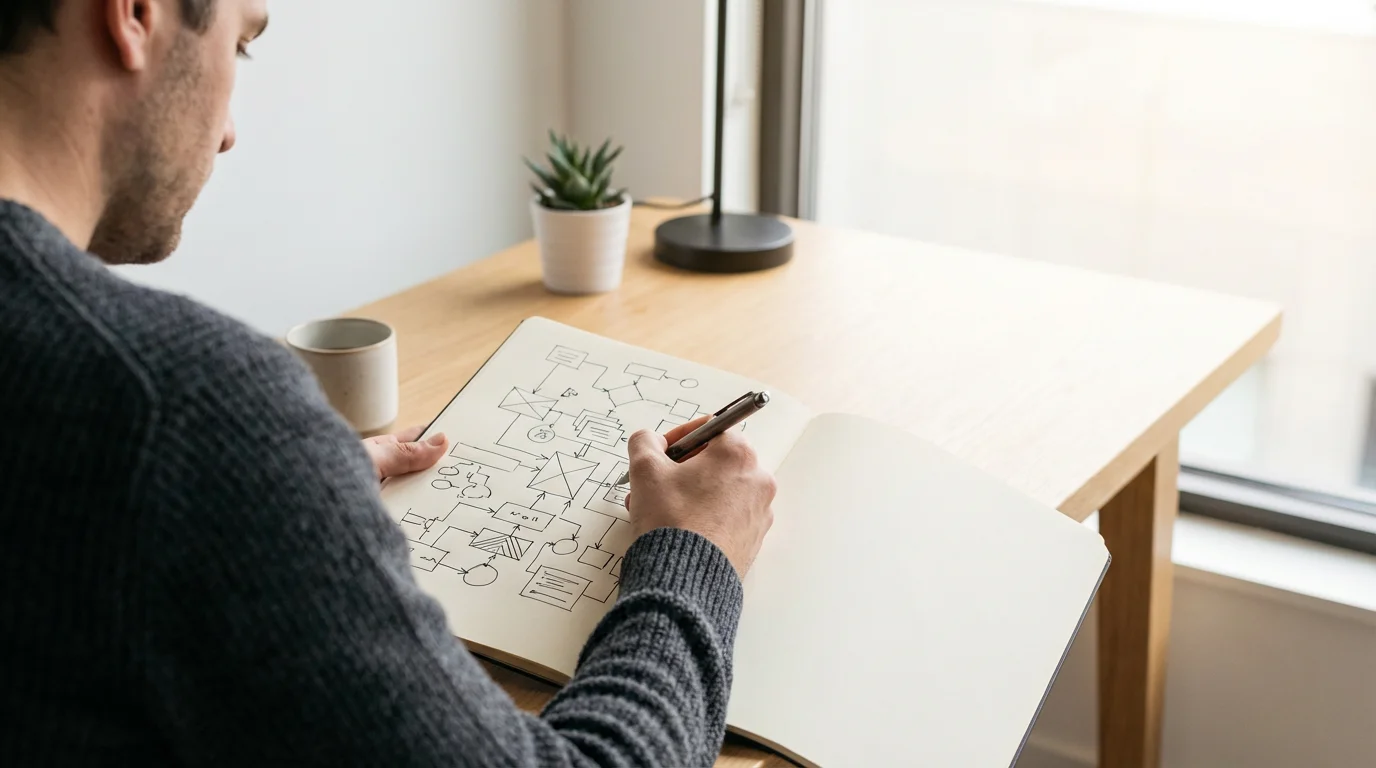
Person sketching abstract diagrams at a desk at night with a phone face down.
Identify what pulls you out of focus and proactively block distractions to sustain your momentum.

Troubleshooting Flow Blockers and Sustaining Momentum

Even with the best preparation, you will encounter challenges in reaching or sustaining flow. Recognizing common pitfalls and having strategies to overcome them allows you to maintain momentum and achieve flow state at work more reliably.

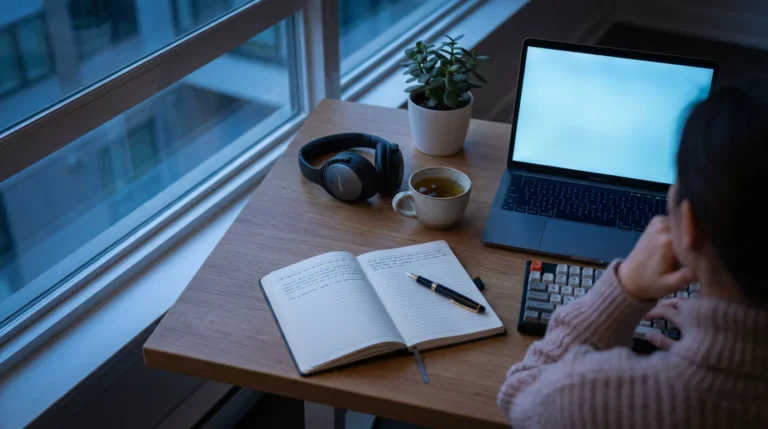
Flat lay of organized desk with tea and glasses during blue hour evening work.
Master your environment: simple tweaks like lighting and hydration can dismantle flow blockers before they start.

Common Flow Blockers and Solutions

Identify what typically pulls you out of your focused state and proactively address it.

  • **External Interruptions:**
    • Blocker: Colleagues dropping by, phone calls.
    • Solution: Use a “Do Not Disturb” sign, communicate your deep work hours, close your office door, or use noise-canceling headphones.
  • **Internal Distractions (Mind Wandering):**
    • Blocker: Thoughts about other tasks, personal worries, creative blocks.
    • Solution: Keep a “distraction notepad” to jot down distracting thoughts for later review. Practice mindfulness to gently redirect your attention back to the task. If creativity stalls, step away for a short walk to reset.
  • **Lack of Clarity:**
    • Blocker: Unsure where to start or what the next step is.
    • Solution: Before beginning, spend 5-10 minutes clearly outlining your task and its immediate steps. Break down complex tasks into smaller, more manageable chunks.
Wide shot of a modern creative lounge with a professional working near large windows.
Adapting your environment helps sustain flow across different locations and longer timeframes.

Maintaining Momentum Over Longer Periods

Flow is not a one-time event; it is a skill you cultivate. Sustaining momentum over hours or even days requires a strategic approach to energy management and environment reinforcement.

  • **Scheduled Micro-Breaks:** Implement short, active breaks every 60-90 minutes. Stand up, stretch, look out a window, or walk to get water. These breaks prevent mental fatigue and promote sustained focus.
  • **Change of Scenery (When Possible):** If you feel stuck, changing your physical location for a short period can sometimes reset your focus. Move to a different room, a quiet cafe, or even a comfortable chair.
  • **Review Progress:** Briefly review what you have accomplished at the end of a deep work session. This provides positive reinforcement and strengthens the neural pathways for achieving flow.
  • **Protect Your Flow Times:** Treat your scheduled deep work blocks as sacred appointments. Defend them against interruptions, both external and self-imposed.
Macro photography of noise-canceling headphones on a wooden table representing portable focus.
Carry your sanctuary with you: portable tools like noise-cancellation can trigger flow anywhere.

Adapting Your Flow Environment to Any Context

Achieving flow state is not exclusive to a perfectly designed home office. You can apply these principles to various work settings, ensuring creative focus triggers are available wherever you are.

Home office desk in moody afternoon sunlight with dramatic shadows and plants.
Defining a physical workspace within your home creates a mental boundary that triggers deep focus.

Remote Work and Home Office

For remote professionals, establishing clear boundaries and routines is paramount. Your home environment often blurs lines between personal and professional life.

  • **Dedicated Workspace:** Even if it is a corner of a room, designate a specific area solely for work. This mental demarcation is powerful.
  • **Family/Housemate Communication:** Clearly communicate your “deep work” hours to those you live with. Use visual cues, such as a closed door or a specific headset, to signal unavailability.
  • **End-of-Day Ritual:** Create a ritual to mark the end of your workday, such as tidying your desk, shutting down your computer, or taking a short walk. This helps you transition out of work mode.
Flat lay of organized office desk with laptop and headphones in cool blue evening lighting.
Creating a consistent, organized physical setup helps anchor your focus, even in a busy open-plan office.

Traditional Office Environments

Open-plan offices present unique challenges, but you can still create pockets of focus.

  • **Noise-Canceling Headphones:** These are your best defense against auditory distractions. Choose comfortable, high-quality over-ear headphones.
  • **Visual Barriers:** If possible, arrange your desk to face a wall or use desk dividers to create a sense of enclosure.
  • **Utilize Quiet Zones:** Seek out library spaces, meeting rooms, or designated quiet areas for your deep work sessions. Book these in advance if necessary.
  • **Signal Unavailability:** Use your status on communication apps (e.g., “In focus mode”) or a small desktop sign to deter interruptions.
Professional working on laptop in a sunny co-working space representing hybrid work flexibility.
Whether at a hub or a coffee shop, a consistent digital setup anchors your workflow.

Hybrid and Flexible Work Models

When switching between locations, consistency in your pre-flow rituals and digital setup helps maintain continuity.

  • **Portable Focus Toolkit:** Keep a small bag with your essential focus items: noise-canceling headphones, a specific pen/notebook, and perhaps a small plant or stress ball.
  • **Consistent Digital Setup:** Ensure your cloud storage and application settings are synchronized across all devices. This minimizes friction when switching between different computers or locations.
  • **Adapt Your Rituals:** Your pre-flow ritual might need slight adjustments depending on your location, but the core steps (e.g., clearing the mind, defining the task) should remain constant.
Freelancer working on laptop outdoors on urban steps during golden hour.
Mastering the art of adaptability: Finding your flow state regardless of the location.

Freelancers and On-the-Go Professionals

Achieving flow in varied environments requires adaptability and a strong internal locus of control.

  • **Scout Locations:** Identify cafes, co-working spaces, or public libraries that offer suitable levels of quiet and comfort for focused work.
  • **Power Management:** Always ensure your devices are charged and you have access to power outlets.
  • **Minimalist Setup:** Travel light with only essential items. Rely on cloud-based tools for accessibility from any device.
  • **Environmental Scans:** Upon arriving at a new location, quickly assess potential distractions (e.g., loud speakers, high traffic areas) and choose a spot that minimizes them.

Frequently Asked Questions

What are the key elements required to achieve a flow state?

Achieving flow requires a clear goal, immediate feedback on progress, a balance between challenge and your skill level, and a lack of distractions. When these elements align, you become fully absorbed in the activity, enhancing creative output.

How long does it take to enter a flow state?

The time to enter a flow state varies. For some, it might take 15-20 minutes of uninterrupted focus. Others might require 30-45 minutes. Consistent practice with environmental hacks and focus techniques, such as the Pomodoro Technique, can shorten this entry time over time.

Can I force myself into a flow state?

You cannot directly force flow, but you can create optimal conditions for it to emerge. By minimizing distractions, setting clear objectives, and engaging in challenging yet manageable tasks, you significantly increase your likelihood of entering flow. It is about preparation, not brute force.

Is flow state only for creative tasks?

No, flow state applies to a wide range of activities, including analytical tasks, physical challenges, and routine work. Any activity that demands full engagement and offers clear feedback can lead to flow. For professionals, this often translates to complex problem-solving or deep analysis.

How can I maintain a flow state once I achieve it?

To maintain flow, protect your environment from interruptions, stay hydrated, and take short, purposeful breaks to prevent fatigue. Ensure your task continues to offer sufficient challenge and clear feedback. If you feel your focus wavering, gently guide your attention back to the task’s core elements.

What role does self-care play in achieving flow state at work?

Self-care is fundamental. Adequate sleep, proper nutrition, regular exercise, and stress management directly impact your cognitive resources. A well-rested and less-stressed mind has a far greater capacity for sustained focus and creative output, making flow more accessible.

This article is for informational purposes only. It does not constitute medical, psychological, or legal advice. Always consult with a qualified professional for specific guidance tailored to your individual needs.

Share this article

Facebook Twitter Pinterest LinkedIn Email

Leave a Reply Cancel reply

Your email address will not be published. Required fields are marked *

Search

Latest Posts

  • Unleash ‘Flow State’: Hack Your Environment for Peak Creative Productivity - guide Unleash 'Flow State': Hack Your Environment for Peak Creative Productivity
  • The Art of the ‘Digital Sabbath’: Disconnecting for Enhanced Creativity and Focus - guide The Art of the 'Digital Sabbath': Disconnecting for Enhanced Creativity and Focus
  • Detoxify Your Digital Space: 7 Steps to a More Mindful Online Experience - guide Detoxify Your Digital Space: 7 Steps to a More Mindful Online Experience
  • Taming the Notification Beast: Your Guide to Intentional Notification Management - guide Taming the Notification Beast: Your Guide to Intentional Notification Management
  • From Chaos to Calm: Design Your Ideal Work-Life Boundaries as a Remote Parent - guide From Chaos to Calm: Design Your Ideal Work-Life Boundaries as a Remote Parent
  • The 30-Minute Focus Sprint: A Powerful Time Management Technique for Hyperfocus - guide The 30-Minute Focus Sprint: A Powerful Time Management Technique for Hyperfocus
  • Reclaim Your Day: Mastering Asynchronous Communication for Focused Work - guide Reclaim Your Day: Mastering Asynchronous Communication for Focused Work
  • Craft Your ‘Anti-Schedule’: The Flexible Time Management Tool for Unpredictable Days - guide Craft Your 'Anti-Schedule': The Flexible Time Management Tool for Unpredictable Days
  • The Visual Goal Board: Using Imagery to Manifest Your Desired Future - guide The Visual Goal Board: Using Imagery to Manifest Your Desired Future
  • Setting Intentions, Not Resolutions: The Power of Focus in the New Year - guide Setting Intentions, Not Resolutions: The Power of Focus in the New Year

Newsletter

Get productivity tips and insights delivered to your inbox.

Related Articles

The Best Productivity Advice Youโ€™ll Ever Get Is to Do Nothing - comprehensive guide

The Best Productivity Advice Youโ€™ll Ever Get Is to Do Nothing

Learning to distinguish between productivity vs. being busy is the first step toward reclaiming your…

Read More โ†’
Inner Critic Silence: Mastering Mindset for Peak Performance - comprehensive guide

Inner Critic Silence: Mastering Mindset for Peak Performance

Learn to silence your inner critic and master your mindset for peak professional performance with…

Read More โ†’
Are You a “To-Do List” Addict? How to Use Lists More Productively - guide

Are You a “To-Do List” Addict? How to Use Lists More Productively

Often, this behavior stems from a deeper cycle where we feel addicted to being busy…

Read More โ†’
How to Use the “2-Minute Rule” for Better Productivity - comprehensive guide

How to Use the “2-Minute Rule” for Better Productivity

Do you ever stare at your to-do list and feel a wave of exhaustion before…

Read More โ†’
Unlock Your Flow State: Proven Techniques to Tap Into Peak Performance - guide

Unlock Your Flow State: Proven Techniques to Tap Into Peak Performance

Unlock your flow state with proven techniques. Boost peak performance, productivity, and focus at work…

Read More โ†’
Why You’re Addicted to Being Busy (And How to Stop) - comprehensive guide

Why You’re Addicted to Being Busy (And How to Stop)

This transformation requires a significant mindset shift in how you view your daily accomplishments. Does…

Read More โ†’
Harness the Power of Visualization: Achieve Your Goals Through Mental Rehearsal - guide

Harness the Power of Visualization: Achieve Your Goals Through Mental Rehearsal

Unlock your potential with visualization. Learn step-by-step how to mentally rehearse and achieve your goals…

Read More โ†’
Your Guide to Achieving a Digital Wind-Down Routine - comprehensive guide

Your Guide to Achieving a Digital Wind-Down Routine

Understanding how your phone is stealing your sleep is the first step toward reclaiming your…

Read More โ†’
Cultivating Mental Clarity: Simple Practices for a Sharper, More Focused Mind - guide

Cultivating Mental Clarity: Simple Practices for a Sharper, More Focused Mind

Learn simple, science-backed practices to cultivate mental clarity and a sharper, more focused mind for…

Read More โ†’
๐ŸŽฏ The Focused Method

Clear Mind. Better Habits.

Urban Pulse Management L.L.C.-FZ
Dubai, UAE

contact@thefocusedmethod.com

Trust & Legal

  • Editorial Policy
  • Terms and Conditions
  • Privacy Policy
  • CA Privacy Policy
  • Request To Know
  • Request To Delete
  • Subscribe
  • Unsubscribe
  • Contact Us

Categories

  • Digital Wellness
  • Habit Building
  • Mindset & Focus
  • Organized Living
  • Productivity Hacks
  • Setting Goals
  • Time Management

© 2026 ๐ŸŽฏ The Focused Method. All rights reserved.